Vallisneria spiralis: the original background plant
Before Dutch aquascaping, before Amano, before any style had a name — there was Vallisneria. It has filled the backgrounds of aquariums for well over a century, and for good reason.
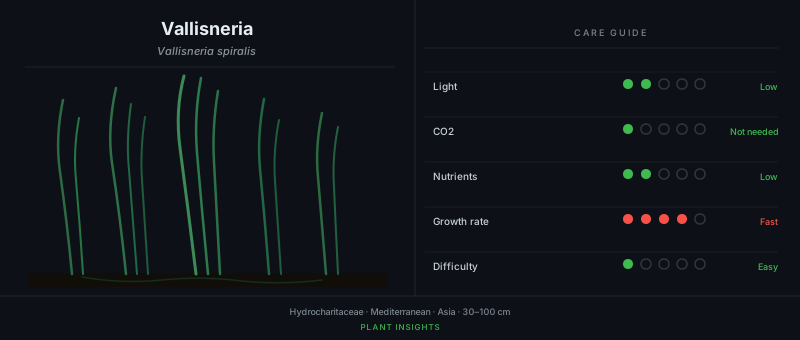
A plant with a global footprint
Vallisneria spiralis is native to the Mediterranean basin and warm temperate regions of Asia, but it has naturalised across the tropics and subtropics so thoroughly that its original range is difficult to define. It grows in slow-moving to still freshwater: lakes, ponds, irrigation channels, river margins, and the sheltered backwaters of larger rivers. In Europe it is found in the rivers of southern France, Italy, and North Africa; in Asia it grows across India, China, and into Southeast Asia.
Its preferred environment is warm (20–30°C), nutrient-rich, and with moderate light. It tolerates considerable variation in water hardness — it is one of the few true aquarium plants that genuinely performs well in hard tap water, which partly explains its century-long popularity in the hobby.
Long, ribbon-like, and restless
The defining characteristic of V. spiralis is its long, flat, ribbon-like leaves — bright to mid-green, slightly translucent, and often with a gentle twist along their length (the spiralis name refers not to the leaves but to the spiral stalk of the female flower). In a mature tank with adequate light, the leaves reach 40–80 cm and float across the water surface in currents from the filter. Multiple plants grow in dense stands that create a convincing sense of a submerged meadow or forest edge.
The closely related Vallisneria nana (sometimes sold as 'Vallisneria Asiatica') has narrower, shorter leaves and is better suited to smaller tanks where spiralis would overwhelm the space.
How to keep it
| Parameter | Value |
|---|---|
| Lighting | Low to medium — 15–50 µmol/m²/s PAR |
| CO2 | Not required; see note on liquid carbon below |
| Temperature | 20–30°C |
| pH | 6.5–8.5 (tolerates hard, alkaline water well) |
| Hardness | Soft to very hard (2–25 °dH) |
| Fertiliser | Low to medium; benefits from root tabs and water column macros |
| Substrate | Fine-grained preferred; root feeder, so nutrient-rich substrate helps |
| Growth rate | Fast — in good conditions, multiple new leaves per week |
Vallisneria's fast growth is both its greatest strength and its main management challenge. In a well-lit, nutrient-rich tank it can carpet the surface with floating leaves within weeks, shading out everything below. Regular trimming of leaf tips (or removal of entire older leaves at the base) is part of keeping it in a community planted tank. In a species or biotope tank with no height restriction it can simply be allowed to run.
Liquid carbon will kill Vallisneria
Glutaraldehyde-based liquid carbon products (sold as Easycarbo, Excel, and similar) are acutely toxic to Vallisneria. Even the low doses used for algae control cause rapid, catastrophic leaf melt — often within 24–48 hours of dosing. If your tank contains Vallisneria, do not use these products. CO2 injection is safe and compatible; liquid carbon alternatives are not.
Runners — the management question
Vallisneria propagates exclusively via runners: horizontal stolons that spread across or just under the substrate and produce new daughter plants at intervals. A healthy established plant can produce a runner every 1–2 weeks, and a tank planted with even 4–5 individuals can fill the background within a month.
Managing runners is an ongoing maintenance task. Simply pull or cut unwanted runners before they anchor. Daughter plants can be replanted where density is wanted, or given away.
Vallisneria also produces flowers: female plants send a spiralling flower stalk to the surface; male plants release tiny pollen-bearing flowers that drift to the females. Pollination occasionally produces seeds, though vegetative propagation via runners is the practical reality in the aquarium.
Where it works best
Vallisneria belongs in the background — planted in a dense row or cluster at the rear of the tank, where the tall leaves create depth and movement. In a Dutch-style layout it provides the structural rear element that makes the foreground and mid-ground plants visible. In a biotope or naturalistic tank it recreates the feel of a lake margin or slow river edge with very little effort.
Its tolerance of hard water makes it one of the few plants genuinely suited to a hard-water African cichlid or Central American community tank. Most aquatic plants struggle or fail in alkaline, hard water; Vallisneria thrives in it.
What goes wrong
Yellowing leaves. Usually iron or micronutrient deficiency — common in fast-growing plants that deplete trace elements quickly. Dose liquid iron and trace elements weekly or add root tabs near the planting zone.
Leaf tips going brown. Often a sign of physical damage from surface turbulence, or nutrient depletion in older leaves. Trim the browned tips or remove the leaf entirely at the base to encourage new growth.
Sudden melt. If leaves melt rapidly in a tank where Vallisneria was previously growing well, check whether anyone recently dosed a glutaraldehyde product. It is the most common cause of unexplained Vallisneria collapse.
More plants in this series
- Anubias barteri var. nana — the indestructible epiphyte
- Cryptocoryne wendtii — rosette, runner, survivor
- Rotala rotundifolia — the colour-shifting stem plant
- Eleocharis parvula (Dwarf Hairgrass) — the carpet that tests patience