Anubias barteri var. nana: the indestructible epiphyte
If a planted tank has a single rule, it is this: when in doubt, plant Anubias. No other aquatic plant tolerates as wide a range of conditions while still looking genuinely good.
Where Anubias comes from
Anubias barteri var. nana originates in the rainforests of West and Central Africa, principally Cameroon and Nigeria. In the wild it is a rheophyte — a plant adapted to grow attached to rocks and submerged wood in fast-moving, shaded streams and waterfalls. The water it inhabits is soft, acidic, and low in nutrients, filtered through dense forest canopy that limits the light reaching the substrate.
That habitat explains almost everything about how to keep it. The thick, waxy leaves evolved to resist physical abrasion in fast currents and to function under low, broken light. The horizontal rhizome is a specialised stem — not a root — designed to anchor to hard surfaces rather than draw nutrients from soil.
What to expect
The standard nana grows broad, oval-to-spear-shaped leaves of deep, glossy green on short petioles emerging from a horizontal rhizome. Mature leaves reach 3–5 cm in length; the whole plant typically stays under 15 cm tall, making it one of the most versatile mid-ground and foreground plants available.
Several cultivars have become widely available:
- Anubias nana — the standard form, reliable and widely stocked
- Anubias nana 'Petite' — miniature leaves under 2 cm, suited to nano tanks and foreground use
- Anubias nana 'Pangolino' — the smallest cultivar, leaves barely 1 cm
- Anubias nana 'Golden' — yellow-green leaves; requires slightly more light to hold the colour
How to keep it
Anubias is deliberately forgiving. It survives conditions that would stress or kill most other plants. That said, understanding its preferences helps it thrive rather than just survive.
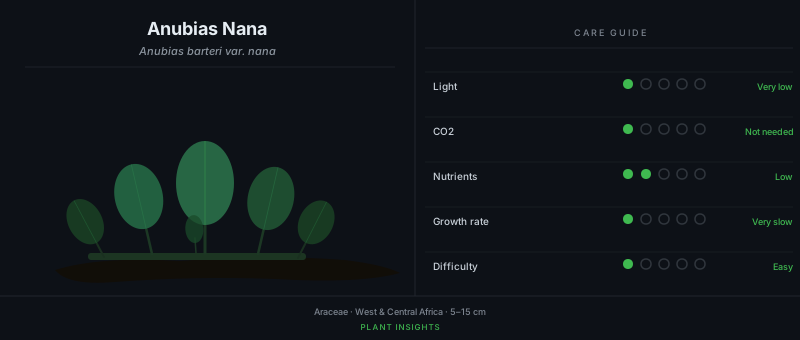
| Parameter | Value |
|---|---|
| Lighting | Very low to low — 10–30 µmol/m²/s PAR |
| CO2 | Not required; will not benefit noticeably if added |
| Temperature | 22–28°C (tolerates 18–30°C) |
| pH | 6.0–8.0 |
| Hardness | Soft to hard (2–20 °dH) |
| Fertiliser | Low; occasional liquid micronutrients beneficial |
| Substrate | Not required — grows on hardscape |
| Growth rate | Very slow — 1–2 new leaves per month under good conditions |
One counter-intuitive rule: do not give Anubias too much light. Its slow growth rate means algae can colonise leaves faster than the plant produces new tissue. In high-light tanks, the broad leaves become a prime surface for green spot algae and black beard algae. Keeping it in a shaded position — tucked under a canopy of faster-growing plants, or in the shadow of a piece of wood — is not a compromise; it is optimal.
The one mistake that kills Anubias
Never bury the rhizome in substrate. The rhizome is not a root — it needs to remain exposed to the water column. Burying it causes rhizome rot, which spreads quickly and is usually fatal to the plant. Roots can be buried; the rhizome must not be.
Where it works best
Anubias is fundamentally a hardscape plant. Attach it to driftwood, rock, or cork bark using black cotton thread or cyanoacrylate gel glue (applied to the rhizome, not the roots). Thread dissolves within a few weeks as the roots grip the surface; glue holds immediately. Within 4–8 weeks the roots anchor firmly enough that the thread or initial bond is no longer needed.
Its compact size and deep green make it a reliable mid-ground anchor in Nature-style layouts and a natural companion to mosses on wood. In biotope tanks representing West African streams, it is arguably the most authentic choice available in the hobby.
How to propagate
Propagation is straightforward: cut the rhizome with sharp scissors, ensuring each section retains at least three leaves. Both pieces will continue growing from the cut end. New growth always emerges from the leading tip of the rhizome, so the cutting with the tip will grow fastest.
Anubias also flowers underwater, producing a cream-coloured spathe. Underwater flowering rarely produces viable seed in aquarium conditions, but the flower itself is an interesting feature of a healthy, well-established plant.
What goes wrong
Algae on leaves. The most common issue. Caused by too much direct light, excess nutrients, or both. Move the plant to a shadier spot, reduce fertiliser, and manually remove algae with a soft cloth or toothbrush. Amano shrimp and nerite snails graze algae from Anubias leaves effectively.
Yellow leaves. Usually iron or micronutrient deficiency. A dose of liquid trace element mix typically resolves it within two or three leaf cycles.
Rhizome rot. Brown, mushy rhizome that spreads toward healthy tissue. Almost always caused by burying. Cut back to healthy green tissue, reattach to hardscape, and increase flow around the plant.