Active substrates and CEC: how aquarium soils work, how hard water degrades them, and what happens when they age
The difference between inert gravel and ADA Amazonia is not marketing — it is electrochemistry. Understanding how cation exchange capacity works explains why your water chemistry matters for substrate longevity, and why the question of whether old aquasoil causes algae is more complex than "it just becomes inert."

What separates active substrate from gravel
Plain gravel, sand, and most decorative substrates are chemically inert. They provide a place for plant roots to anchor but do not interact meaningfully with the water chemistry around them. Active substrates — the category that includes volcanic and peat-based products from ADA, Tropica, Oase, and others — do something structurally different: they hold onto plant nutrients through electrostatic attraction and release them on demand in exchange for other ions. This property is called cation exchange capacity, or CEC.
Understanding CEC at even a basic level changes how you think about substrate choice, water chemistry, water changes, and what is actually happening when a product described as "exhausted" starts behaving unexpectedly.
The electrochemistry: why clay holds nutrients
Clay minerals are built from layered sheets of silicon and aluminium atoms bonded to oxygen. The relevant detail is that these layers carry a permanent negative electrical charge, generated by a process called isomorphous substitution — where lower-valence atoms replace higher-valence ones in the crystal lattice without changing the structure. A silicon (Si⁴⁺) atom replaced by an aluminium (Al³⁺) atom, for example, leaves a net negative charge at that site. These negatively charged sites attract and hold positively charged ions from the surrounding water — the cations — like a series of tiny magnets.[1,2]
The ions held at these sites are exchangeable: they can be displaced by other cations from solution, depending on concentration and charge. This exchange is reversible. A plant root that takes up a potassium ion from solution creates a local concentration gradient that pulls K⁺ off a nearby clay exchange site to replace it. The substrate is, in effect, a slow-release reservoir sitting directly in the plant's root zone.
CEC is measured in centimoles of charge per kilogram of dry substrate (cmol/kg), sometimes written as meq/100g — the two units are numerically equivalent. A higher value means more exchange sites per unit mass, and therefore a greater capacity to hold and buffer nutrients. Typical sandy soils have CEC values of 1–5 cmol/kg. Organic-rich agricultural soils run 15–40 cmol/kg. The clay minerals and volcanic materials used in planted tank substrates sit toward the higher end of that spectrum, though peer-reviewed CEC data specific to commercial aquarium products is not publicly available — manufacturers do not typically publish the laboratory methodology behind their figures.
What CEC is not
CEC describes the capacity to hold exchangeable cations — not the concentration of nutrients already loaded into the substrate. A product with high CEC is not necessarily pre-loaded with nutrients. Some active substrates (like ADA Amazonia) rely partly on the organic nitrogen content of their source material for the initial nutrient spike. Others are fired clay minerals with high CEC but modest pre-loaded nutrient content. The CEC is the mechanism; the loaded nutrients are the content.
Active substrates: what they are made of
Most premium active substrates fall into two broad material categories: volcanic soils and zeolite or clinoptilolite-based substrates. The differences in raw material affect not just CEC magnitude but which ions are preferentially held and at what rate the buffering capacity degrades.
ADA Aqua Soil (Amazonia, Amazonia II, Africana, Malaya) — manufactured in Japan from kiln-fired allophanic volcanic soil. Allophane is a poorly crystalline aluminosilicate mineral found in soils derived from volcanic ash, with unusually high surface area and pH-dependent charge.[10] Allophane-rich soils commonly reach 50–100 cmol/kg in the scientific literature, which helps explain why products in this range are among the most effective at rapid pH and KH reduction. ADA's product literature does not disclose CEC values directly. Amazonia is also notable for relatively high organic nitrogen content from the source soil, which produces the pronounced initial ammonia spike characteristic of new volcanic substrate.
Tropica Aquarium Soil (standard and powder) — produced in Denmark using a formula based on peat-rich volcanic and mineral components, kiln-fired to produce granules that balance physical stability with ion exchange activity. Tropica publishes that their substrate actively binds phosphate as well as cations, which is consistent with the iron and aluminium oxide content known to adsorb phosphate in volcanic and peat soils. Their product is designed to lower pH toward 6–7 and reduce carbonate hardness, consistent with a high CEC and active H⁺ buffering mechanism.
Oase ScaperLine Soil — a German product also based on fired clay granules, with manufacturer claims of active pH reduction and long-term nutrient retention. The granule structure is engineered for stability to resist compaction over time. Oase markets this substrate alongside their ScaperLine filtration and dosing products, positioning it as part of a managed system rather than a standalone solution.
Other notable options — UP Aqua Shrimp Sand is widely used in soft water shrimp tanks for its consistent pH reduction and is chemically similar in mechanism to the above. Zeolite substrates (including some products based on clinoptilolite) work by ion exchange in the same way but have a different ion selectivity sequence: clinoptilolite preferentially holds K⁺ > NH₄⁺ > Na⁺ ahead of Ca²⁺ and Mg²⁺, making it particularly effective as an ammonium absorber in aquaculture and some aquarium applications.[7] Akadama, a fired Japanese clay used primarily in bonsai, has a modest but real CEC and is used by some planted tank keepers as an inexpensive substrate with mild buffering properties. Laterite, a tropical iron-rich clay soil, has lower CEC than volcanic substrates but provides a long-term iron reservoir when used as a lower layer beneath inert capping. Root-zone iron from laterite supplements but does not replace water-column iron dosing for epiphytes, which feed through their leaves rather than roots (how plants take up nutrients) — and the form of chelated iron you dose matters significantly at neutral or alkaline pH; see the guide to iron chelate selection.
The initial ammonia spike: a submerged soil mechanism
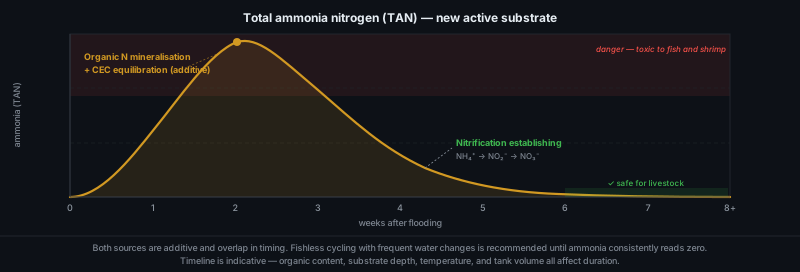
Almost every active substrate causes an ammonia spike in the first days to weeks after flooding. This is reliable enough to be treated as a given in setup guides, but the mechanism is rarely explained. It has two additive components.
The first is mineralisation of organic nitrogen. Many active substrates contain organic matter — decomposed plant material, peat, or the humus-like compounds present in volcanic soil. When this organic matter is flooded and anaerobic conditions begin to develop in the lower substrate, heterotrophic bacteria decompose organic nitrogen compounds into ammonium (NH₄⁺). Critically, anaerobic conditions suppress nitrification — the bacterial conversion of NH₄⁺ to nitrate — so ammonium accumulates in the porewater rather than being oxidised away. Research on paddy soils, which replicate this chemistry closely, shows that organic carbon content and flooding conditions together drive rapid initial NH₄⁺ accumulation.[8,9]
The second component is CEC equilibration. The substrate arrives pre-loaded with NH₄⁺ at exchange sites from its manufacturing and storage history. When flooded, the system equilibrates with the surrounding water: some of that ammonium desorbs from exchange sites and enters the water column until a new equilibrium is established. The rate depends on the substrate's total NH₄⁺ loading and the ambient water chemistry. This pre-loading is characteristic of aquasoil-type products derived from organic-rich volcanic or composted materials; many fired mineral substrates — including some laterite-based or fired clay products — are not significantly pre-loaded with NH₄⁺ and may not produce a pronounced initial ammonium spike.
Both processes peak in the first two weeks and then decline as organic nitrogen is exhausted and as nitrifying bacteria — including Comammox Nitrospira, which thrive in the low-ammonia conditions that follow initial cycling — establish themselves in the substrate.† This is why fishless cycling during this period is standard practice, and why frequent water changes during cycling reduce the risk to sensitive inhabitants.
† See: Comammox: the bacteria rewriting the nitrogen cycle
pH and KH reduction: the buffering mechanism
Active substrates reduce pH and carbonate hardness (KH) through a direct ion exchange reaction. The clay mineral's exchange sites release hydrogen ions (H⁺) in exchange for calcium (Ca²⁺) and magnesium (Mg²⁺) drawn from the water column. Each Ca²⁺ absorbed by the substrate releases two H⁺ ions. Those hydrogen ions acidify the water and react with bicarbonate (HCO₃⁻) — the anion that constitutes KH — converting it to CO₂ and water. The result is simultaneous pH reduction and KH reduction from a single exchange reaction.
This is why the same substrate that lowers pH also consumes KH: the two effects are not separate phenomena but different expressions of the same H⁺/Ca²⁺ exchange. It is also why the substrate's effect on pH is limited in hard water — the water continuously replenishes the Ca²⁺ and Mg²⁺ being absorbed, and the H⁺ released is rapidly consumed by the abundant bicarbonate buffer. The substrate works against a chemical headwind. This is where water hardness and CEC longevity become inseparable topics.
Hard water versus soft water: how Ca²⁺ and Mg²⁺ deplete CEC
The exchange sites on a clay mineral have a limited capacity. Once they are occupied, they cannot hold additional ions until those occupying ions are released. The question of substrate longevity is therefore largely a question of what fills those sites, and how fast.
In hard water — tap water with high GH and KH, meaning high concentrations of dissolved calcium and magnesium — the substrate's exchange sites are continuously exposed to large quantities of Ca²⁺ and Mg²⁺. These divalent cations compete directly with the plant-available cations (K⁺, NH₄⁺, Fe²⁺) for the same negative sites. Over time, mass action favours the more abundant ions: Ca²⁺ and Mg²⁺ progressively displace K⁺ and NH₄⁺ from exchange sites and fill them. Laboratory studies using clinoptilolite zeolite in aquaculture water confirm this competitive displacement directly — the presence of calcium in the water depresses ammonium exchange capacity measurably, and successive exposure cycles with calcium-rich water progressively saturate the zeolite's NH₄⁺-holding ability.[3,4]
In a tank run on soft water or RO water with low Ca²⁺ and Mg²⁺ concentrations, this displacement happens slowly. The exchange sites remain available for plant-relevant cations, the substrate continues to buffer pH and KH, and the effective lifespan of the active properties is substantially extended. Keepers who use RO water remineralised to low GH/KH consistently report active substrate behaviour lasting three to five or more years. Those running hard tap water directly often notice the substrate's buffering effect fading within twelve to eighteen months. (These timelines are anecdotal hobbyist estimates; actual lifespan varies significantly with stocking density, plant load, water change frequency, and the specific substrate product.)
This is why RO water is often recommended with active substrates
The recommendation to use RO water in active substrate tanks is not only about achieving target pH and KH. It directly reduces the rate at which Ca²⁺ and Mg²⁺ saturate the substrate's exchange sites. Lower hardness = slower site saturation = longer effective substrate lifespan. For more on how to use the RO Mixer to dial in your target chemistry, see AquaCalc's RO water mixing tool.
It is worth noting that the selectivity sequence — the order in which a given clay mineral prefers to hold different cations — varies between clay types. Clinoptilolite zeolite preferentially holds K⁺ over NH₄⁺ over Na⁺, and prefers all of these over Ca²⁺ and Mg²⁺ at dilute concentrations.[3] This means a zeolite substrate in moderately hard water will retain plant-available nutrients at its exchange sites somewhat longer than a smectite-type clay would, because the selectivity works in the plant's favour. Allophanic soils (volcanic, as used in ADA products) behave differently again — their pH-dependent charge means selectivity shifts with pH, and their very high surface area makes total site capacity large even if individual site preferences differ from zeolite.
What actually happens as substrate ages
The conventional account of aged active substrate goes something like this: the substrate gradually loses its buffering capacity, pH climbs back toward neutral, KH rises, and eventually the substrate behaves like inert gravel. This account is broadly correct as far as it goes — but it describes only part of what is happening.
CEC sites do not disappear. The clay mineral's crystal structure is stable over the timescales relevant to an aquarium. The negative lattice sites that enable ion exchange remain intact. What changes is what occupies those sites. As Ca²⁺ and Mg²⁺ progressively fill the exchange positions, fewer sites remain available for plant-relevant cations. The substrate becomes, in the language of soil science, saturated with respect to calcium and magnesium. It is no longer inert in a chemical sense — the exchange sites still exist and still participate in ion exchange — but the net effect on the water column changes character: instead of pulling Ca²⁺/Mg²⁺ out of the water and releasing H⁺, the equilibrium shifts, and the substrate no longer drives pH or KH down meaningfully.
Physical degradation occurs in parallel. Kiln-fired granules are durable but not permanent. Substrate particles gradually break down under physical disturbance (replanting, digging by fish, water flow through the bed), releasing fine particles that compact the lower layers. Compaction reduces the water and gas exchange through the substrate profile, creating more strongly reducing (anaerobic) conditions in deeper zones. This is a slow process over years, but it is meaningful for what happens to nutrient dynamics in the lower substrate — particularly phosphorus.
Organic matter accumulates. Fish waste, plant detritus, uneaten food, and dead microbial biomass settle into and onto the substrate continuously. Over the years of a mature tank, a significant layer of organic material — hobbyists call it mulm — builds up within the substrate matrix. This organic accumulation has its own chemical consequences, independent of the clay mineral's CEC properties, and this is where the "aged substrate causes algae" discussion becomes scientifically interesting.
Old substrate and algae: what the evidence says
Experienced planted tank keepers frequently report a pattern: in a tank that has been running for several years with what appears to be exhausted substrate, persistent algae problems develop that do not respond to the usual interventions — reduced lighting, CO₂ adjustment, dosing corrections. The substrate is often the suspected culprit. The hobbyist explanation is typically that the substrate "releases nutrients" or "has gone bad." But what might actually be happening, and is there science that speaks to it?
The honest answer is that no peer-reviewed research has specifically studied aged planted aquarium substrates and algae. The relevant evidence comes from a different but closely analogous system: freshwater lake sediments. The dynamics of nutrient cycling in shallow lake sediment are well-studied in limnology, and the parallels to a planted tank substrate are direct.
The sediment phosphorus mechanism
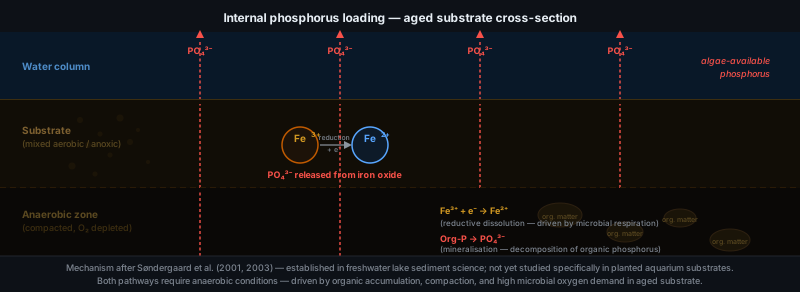
In freshwater lakes, a well-documented phenomenon called internal phosphorus loading occurs when phosphorus that was previously buried in sediment is released back into the water column. Søndergaard and colleagues have shown extensively that in shallow lakes, internal P loading from sediment can account for the majority of phosphorus in the water during summer months, even when external phosphorus inputs have been eliminated entirely.[5,6] The mechanism involves two interconnected processes.
The first is reductive dissolution of iron-bound phosphate. Under oxic (oxygenated) conditions, phosphate in sediment binds strongly to iron(III) oxides and hydroxides — effectively locking it in the sediment. When anaerobic conditions develop in the sediment — as they do in compacted, organic-rich substrate where microbial oxygen demand exceeds diffusion from the water column — iron(III) is reduced to iron(II) by bacterial respiration. Iron(II) does not bind phosphate effectively, and the previously locked phosphate is released into the porewater, from which it diffuses upward into the water column.[5]
The second process is mineralisation of organic phosphorus. Organic matter in sediment — fish waste, plant detritus, dead bacteria — contains phosphorus in organic form. As this material decomposes through microbial activity, the organic phosphorus is hydrolysed to inorganic orthophosphate (PO₄³⁻), which is soluble and can diffuse out of the substrate into the water column.[6]
Both processes are driven by the same root conditions: organic matter accumulation and anaerobic zones in the substrate. A planted aquarium substrate that has been running for several years has accumulated organic matter, has developed compacted lower layers with reduced oxygen penetration, and may have significant iron-bound phosphorus from years of fertiliser dosing and fish waste. The conditions that trigger internal phosphorus loading in lake sediments are plausibly present.
"Internal loading from sediments accounted for more than half of the summer phosphorus discharge [in shallow lakes], even after external loading was substantially reduced." — Søndergaard et al. (2003)[6]
There are, however, important caveats to applying this mechanism directly to an aquarium. Lake sediments and aquarium substrates differ in several ways. Lakes accumulate sediment over decades; aquarium substrate accumulates mulm over years. The volume ratios are very different. The turnover from water changes and active filtration in an aquarium removes phosphorus from the water column at a much higher rate than occurs in a natural lake. And a heavily planted aquarium has a large living phosphorus sink — the plants themselves — that competes with algae for any phosphorus released from the substrate.
What the lake sediment science provides is a plausible mechanism by which aged substrate could release bioavailable phosphorus into the water column. Whether this occurs at a rate sufficient to cause observable algae problems in a planted aquarium, and under what conditions, is not yet established in peer-reviewed literature. The anecdotal hobbyist reports are consistent with the mechanism but are not controlled observations — confounding variables (lighting changes, CO₂ drift, increased fish stocking over time, filter efficiency changes) make it impossible to attribute causation from forum reports alone.
What this means in practice
The science supports taking aged substrate seriously as a potential phosphorus source — particularly in tanks that have accumulated significant mulm, have compacted lower substrate, and where persistent algae problems have not responded to water column interventions. Substrate disturbance (replanting, stirring) can cause short-term spikes as accumulated porewater nutrient is mixed into the water column; this is well-documented in the lake literature and consistent with hobbyist experience of algae flares after major replants in old tanks.
Using AquaCalc's parameter log to track phosphate over time — particularly noting whether readings are elevated despite consistent dosing and water change practice — can help identify whether substrate efflux is contributing to elevated water column phosphorus.
Does aged aquasoil "go bad" in other ways?
Beyond phosphorus, aged substrate may accumulate other compounds that are less well characterised. Hydrogen sulphide (H₂S) is produced in strongly anaerobic substrate zones by sulphate-reducing bacteria; it is toxic to fish and roots in sufficient concentration and has a distinctive "rotten egg" smell when substrate is disturbed. In a healthy, planted substrate with good root penetration, H₂S rarely accumulates to harmful levels because plant roots release oxygen into the rhizosphere, maintaining locally aerobic conditions. In a tank with sparse plant cover, compacted substrate, and high organic loading, H₂S accumulation is more plausible.
Manganese and iron can also be released from anaerobic substrate into the water column in reduced form (Mn²⁺, Fe²⁺). Both are plant nutrients in trace quantities but can be problematic in excess and may contribute to brown discolouration or, in the case of iron, brief precipitation events. Again, these dynamics are better documented in the lake literature than in planted aquarium research specifically.
Reading your substrate's chemistry
The pH Monitor provides the most direct practical signal about what your substrate is still doing. If you are running an active substrate with soft or RO water and your pH at CO₂-off overnight is noticeably higher than it was in the tank's first year, that shift reflects the substrate's reduced buffering capacity. The substrate is still exchanging ions — but the equilibrium has shifted as Ca²⁺/Mg²⁺ saturation increases. A parameter log maintained over the life of a tank makes this drift visible where it would otherwise be imperceptible session to session.
KH is the other direct indicator. If your tank started at KH 0–1 with RO water and a new active substrate, and KH has gradually crept upward over years despite your water change water remaining soft, the substrate's buffering capacity has been consumed. This is not a failure — it is expected behaviour — but it is informative about where you are in the substrate's life cycle.
For new setups, the AquaCalc substrate calculator can help determine the volume of substrate needed for your tank dimensions, accounting for the recommended depth for planted tanks (typically 6–8 cm at the back, shallower at the front).
When to consider substrate replacement
This depends almost entirely on why you are keeping the tank. A long-running nature aquarium or Dutch layout that has been running for five or more years on soft water may have a substrate that is largely saturated but still functioning adequately as a root anchor with residual exchange capacity — and the accumulated organic layer may actually support lush growth through mineralisation. Many experienced keepers choose to run the same substrate indefinitely, managing water chemistry through water changes and dosing rather than relying on substrate buffering.
The case for replacement is stronger when: (1) persistent algae problems have not responded to conventional interventions and other causes have been ruled out; (2) the substrate has physically degraded to the point of significant compaction with no plant cover to maintain aerobic zones; or (3) the tank is being rescaped and a return to active pH buffering from the substrate is desired for a new planting plan.
Partial substrate replacement — removing the top layer and adding fresh active substrate on top — is an option that avoids full disruptive rescaping but introduces a period of renewed ammonia cycling that must be managed. Full replacement in an established, stocked tank is a significant undertaking and should be planned carefully, with attention to water chemistry changes during the transition.
Scientific references
- Sparks, D.L. (1985). "Kinetics of Ionic Reactions in Clay Minerals and Soils." Advances in Agronomy, 38, 231–266.
- Nommik, H. & Vahtras, K. (1982). "Retention and Fixation of Ammonium and Ammonia in Soils." In: Stevenson, F.J. (ed.), Nitrogen in Agricultural Soils. Agronomy Monograph 22, pp. 123–171. American Society of Agronomy.
- Dryden, H.T. & Weatherley, L.R. (1987). "Aquaculture Water Treatment by Ion-Exchange: II. Selectivity Studies with Clinoptilolite at 0.01 N." Aquacultural Engineering, 6(4), 275–292. doi:10.1016/0144-8609(87)90018-5
- Dryden, H.T. & Weatherley, L.R. (1989). "Aquaculture Water Treatment by Ion Exchange: Continuous Ammonium Ion Removal with Clinoptilolite." Aquacultural Engineering, 8(2), 109–126. doi:10.1016/0144-8609(89)90008-3
- Søndergaard, M., Jensen, J.P. & Jeppesen, E. (2001). "Retention and Internal Loading of Phosphorus in Shallow, Eutrophic Lakes." The Scientific World Journal, 1, 427–442. doi:10.1100/tsw.2001.72
- Søndergaard, M., Jensen, J.P. & Jeppesen, E. (2003). "Role of Sediment and Internal Loading of Phosphorus in Shallow Lakes." Hydrobiologia, 506–509, 135–145. doi:10.1023/B:HYDR.0000008611.12704.dd
- Ghasemi, Z., Sourinejad, I., Kazemian, H. & Rohani, S. (2018). "Application of Zeolites in Aquaculture Industry: A Review." Reviews in Aquaculture, 10(1), 75–95. doi:10.1111/raq.12148
- Kader, M., Sleutel, S., Begum, S., Moslehuddin, A. & De Neve, S. (2013). "Nitrogen Mineralization in Sub-tropical Paddy Soils in Relation to Soil Mineralogy, Management, pH, Carbon, Nitrogen and Iron Contents." European Journal of Soil Science, 64(1), 47–57. doi:10.1111/ejss.12005
- Ponnamperuma, F.N. (1972). "The Chemistry of Submerged Soils." Advances in Agronomy, 24, 29–96.
- Parfitt, R.L. (1990). "Allophane in New Zealand — a review." Australian Journal of Soil Research, 28(3), 343–360.
Comments
Add yoursNo comments yet — be the first to share your experience.