Heat stress in aquariums: the science of what extreme temperatures do to your fish and water
When the UK recorded its first 40 °C day in July 2022, aquarists across the country watched their tank thermometers climb into territory that kills fish. The problem is not only that hot water is uncomfortable — it is that the physics of heat and the biology of fish conspire together in a way that turns a warm day into a genuine emergency.
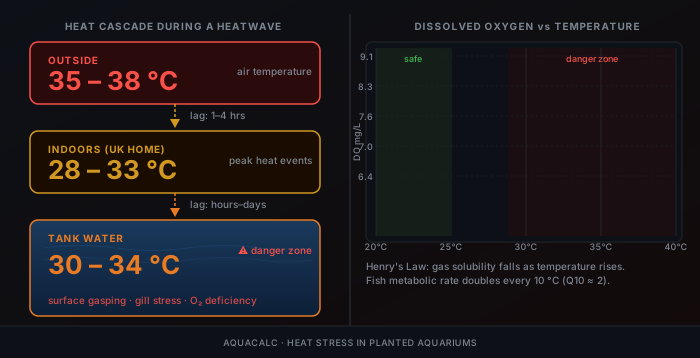
This article covers the science: why heat is so dangerous, what it does at the molecular level, and what the evidence actually says about surviving it. To see how hot your area is forecast to get over the next 14 days, use the AquaCalc aquarium heat forecast tool — it shows outdoor temperatures with Good, Warming, and Extreme risk levels calibrated to the temperatures that actually affect fish.
Part one: how heat gets into your tank
The physics of thermal equilibrium
Water, like any substance, seeks thermal equilibrium with its surroundings. Left alone, tank water will eventually match the ambient air temperature in the room. The question during a heatwave is not whether the water will heat up — it will — but how fast.
Water has a high specific heat capacity: 4,186 joules per kilogram per kelvin. This means a litre of water requires 4,186 J of energy to rise by 1 °C. For a 200 L tank, raising the water from 26 °C to 30 °C requires over 3.3 megajoules of energy. This is why large tanks heat up more slowly than small ones — not because they are better insulated, but because they have more thermal mass to absorb before temperature rises. A 30 L nano tank on a warm windowsill can overheat within a few hours. A 300 L tank in the same room may take a full day.
Heat enters a tank through four pathways:
- Convection from air — the primary route during a heatwave. Warm air over the water surface transfers heat continuously.
- Conduction through glass or acrylic — most aquarium glass is 8–12 mm thick and a poor insulator. Warm room air heats the glass; the glass heats the water.
- Lighting — LED lights add relatively little heat to the water directly, but older T5 and T8 fluorescent tubes and metal halide pendants can add 50–200 W of heat to the system. Even LED fixtures warm the hood and surrounding air, which contributes.
- Pumps, filters and heaters — all electrical equipment running submerged converts electricity to heat. A 20 W circulation pump running continuously adds 20 W of heat to your water, around the clock.
The outdoor-to-indoor lag
Buildings have their own thermal mass. Brick walls, concrete floors and roof insulation absorb heat during the day and release it slowly. This means indoor temperatures typically lag outdoor temperatures by one to four hours, and may continue rising after outdoor temperatures have peaked. During a multi-day heatwave, this lag disappears — by day two or three, indoor temperatures may stay elevated overnight, giving tank water no chance to cool down.
This is why prolonged heatwaves are more dangerous than single hot days. A single afternoon at 35 °C outdoors may raise your tank by 2–3 °C. Three consecutive days at 35 °C, with warm nights, can push even a large tank into the danger zone.
Part two: what temperature does to water chemistry and fish biology
The oxygen squeeze
This is the central danger of heat, and it is a double bind.
Water holds less dissolved oxygen at higher temperatures. This is described by Henry’s Law: the solubility of a gas in a liquid is proportional to the partial pressure of that gas above the liquid, and inversely proportional to temperature. For oxygen in water at sea-level atmospheric pressure, the saturation values are well-established:
- 20 °C — 9.1 mg/L
- 24 °C — 8.4 mg/L (typical tropical target)
- 28 °C — 7.8 mg/L
- 30 °C — 7.6 mg/L
- 32 °C — 7.3 mg/L
- 35 °C — 7.0 mg/L
- 38 °C — 6.6 mg/L
Source: Benson & Krause (1984), standard reference values widely used in environmental science.
This is a physical inevitability. A perfectly aerated tank at 35 °C can hold at most 7.0 mg/L of dissolved oxygen. The same tank at 20 °C can hold 9.1 mg/L. Heat alone removes 23% of the oxygen ceiling before a single fish has taken a breath.
At the same time, fish need more oxygen as temperature rises. Fish are ectotherms — their body temperature tracks their environment. As water warms, every biochemical reaction in a fish’s body speeds up. This relationship is captured by the Q10 coefficient: for most teleost (bony) fish, metabolic rate approximately doubles for every 10 °C rise in temperature (Q10 ≈ 2, though values of 1.5–3.0 have been reported across species). A fish at 32 °C may be consuming approximately 40–75% more oxygen than it did at 24 °C (applying Q10 values of 1.5–2.0, which covers most tropical freshwater species), while the water around it holds significantly less of it.
This is the oxygen squeeze: supply falling, demand rising, at the same time. The practical consequence is that fish can reach critical oxygen thresholds even in a well-aerated tank during extreme heat. Research on tropical freshwater species typically places the critical oxygen threshold (below which fish show acute stress or begin losing equilibrium) between 2–4 mg/L depending on species, size and acclimatisation — but acute stress behaviours such as surface gasping often appear at 5 mg/L or below. The margin between a saturated 35 °C tank (7.0 mg/L) and the stress threshold is narrow, and any reduction in surface agitation or biological oxygen demand narrows it further. For the full picture of how dissolved oxygen affects fish beyond heat events — including the effects on immunity, growth, and reproduction at sub-lethal levels — see the dissolved oxygen guide.
Ammonia becomes more toxic
Ammonia in aquarium water exists in two forms: ionised ammonium (NH4+, essentially non-toxic at normal levels) and un-ionised free ammonia (NH3, toxic). The equilibrium between them shifts with both temperature and pH:
As temperature rises, the equilibrium shifts toward the toxic NH3 form. At pH 7.5 and 25 °C, approximately 1.7% of total ammonia is in the toxic NH3 form (calculated from the temperature-corrected pKa of ammonium). At 30 °C and the same pH, this rises to approximately 2.5%. At 35 °C, it reaches around 3.6%. This may seem like small numbers, but if total ammonia is 1.0 mg/L, free ammonia at 35 °C is approximately 0.036 mg/L — already in the range where many species begin to show chronic toxicity symptoms (EPA chronic ammonia criteria for many freshwater fish are in the low-tenths of mg/L NH3 range). During a heatwave, a tank that tests as “safe” on a total ammonia test at normal temperatures may have elevated toxic ammonia levels without any increase in feeding or stock.
pH further compounds this. As dissolved CO₂ falls with increasing temperature (CO₂ solubility also follows Henry’s Law), aquarium pH can drift slightly upward during extreme heat, which shifts the NH4+/NH3 equilibrium further toward the toxic form. For planted CO₂-injected tanks, CO₂ also degasses faster in hot water, which may affect your overnight pH readings.
Nitrifying bacteria under stress
The nitrifying bacteria responsible for your biological filter — primarily Nitrospira species, the dominant nitrite-oxidising bacteria (and, in some tanks, complete ammonia oxidisers via the comammox pathway) in most established aquariums (see our comammox article for more on this) — have an optimal temperature range of roughly 25–30 °C. Above 35 °C, nitrification rates decline measurably. Above 40 °C, Nitrosomonas-type organisms (historically thought dominant, and still relevant in some systems) begin to die.
In practice this means that during a severe heatwave, when ammonia toxicity is already chemically elevated and fish are under stress producing more waste, the biological filter may simultaneously become less effective at processing it. This compound risk is real but difficult to quantify precisely in a home aquarium context, and the evidence for significant nitrification failure below 35 °C is limited. At temperatures most UK tanks are likely to reach (30–33 °C), nitrification continues, though it may be somewhat reduced. Above 35 °C sustained, the risk of filter instability is more genuine.
Critical thermal maxima and species differences
Fish have a critical thermal maximum (CTmax) — the temperature at which they lose equilibrium and cannot survive. These are species-specific and have been measured experimentally. Some reference points for popular aquarium fish:
- Cardinal tetra (Paracheirodon axelrodi): natural range is blackwater rivers at 24–30 °C. CTmax in laboratory studies: approximately 36–38 °C, but chronic stress occurs well below this.
- Corydoras catfish: variable by species, most prefer 22–26 °C. Sustained temperatures above 30 °C are documented to increase mortality risk.
- Betta splendens: naturally tolerant of warmer, shallower waters; CTmax reported above 40 °C in some studies, though 30–32 °C is considered the comfortable upper limit.
- Caridina neocaridina shrimp: generally more heat-sensitive than fish. Most Caridina species (Crystal Red, Crystal Black) show significant stress and mortality above 26 °C. Neocaridina are somewhat more tolerant but still at risk above 28–30 °C.
If you want to check the specific temperature range recorded for your fish, the AquaCalc fish species lookup shows the FishBase temperature range, pH, hardness and maximum size for thousands of aquarium species.
The important distinction is between acute lethal temperature and chronic stress temperature. A fish may survive a brief excursion to 32 °C but show immune suppression, reduced reproduction and shortened lifespan from sustained exposure at 30 °C. Most published CTmax data uses short-duration ramp tests and does not reflect the impact of days-long elevated temperature exposure.
Part three: warning signs
Recognising heat stress early matters. The following signs have physiological bases:
- Surface gasping — fish hovering at the surface and gulping air is the clearest sign of oxygen deficiency. The surface layer has the highest dissolved oxygen from atmospheric exchange. This is a physiological response to hypoxia, not a behavioural choice.
- Lethargy and loss of appetite — metabolic disruption from temperature extremes suppresses feeding behaviour. This is well-documented across fish species.
- Rapid gill movement — fish breathe by pumping water over their gills. When oxygen is scarce, gill ventilation rate increases to pass more water across the gill surface. This is visible as fast, laboured breathing at the gill cover.
- Unusual swimming behaviour — listing to one side, head-up or tail-up posture, erratic darting. These indicate neurological or muscular disruption from hypoxia or thermal damage to enzyme function.
- Colour fading — chromatophore response to stress is well-established. Pale or washed-out colour in normally vibrant fish is a systemic stress signal.
Shrimp are worth watching separately: they are often the “canary” in a heat event. Shrimp become visibly restless, pace the glass, congregate at the surface or at any area of water movement when oxygen is low. Shrimp deaths before fish deaths during a heatwave are a reliable early warning.
Part four: what you can do — the evidence
It is important to be clear here about what is physically established versus what is hobbyist convention. Where the evidence is strong, it is described as such. Where a strategy is anecdotally reported and physically plausible but not formally studied in aquarium contexts, that is stated.
Increase surface agitation — high confidence
This is the single most important intervention, supported by fundamental gas exchange physics.
Dissolved oxygen enters water through the surface via diffusion. The rate of exchange is proportional to surface area, the concentration gradient (difference between actual DO and saturation DO), and turbulence at the surface. Vigorous surface agitation — from a powerhead, spray bar, or airstone — continuously disrupts the surface film, exposes fresh water to the atmosphere and dramatically increases the rate of oxygenation.
Even if the saturation ceiling is lower at high temperature, maximising actual DO toward that ceiling is critical. A still tank at 32 °C may have DO of 5–6 mg/L. The same tank with aggressive surface movement may sustain 7—7.3 mg/L, a meaningful difference against a background of elevated demand. Adding an airstone during a heatwave is not anecdote; it is straightforward physics.
Note: surface agitation will cause CO₂ to degas faster. If you run CO₂ injection, your pH will rise slightly and CO₂ efficiency will drop during this period. This is an acceptable trade-off — oxygen availability for livestock takes priority over plant growth during an emergency. See the CO₂ section below for more detail on managing this.
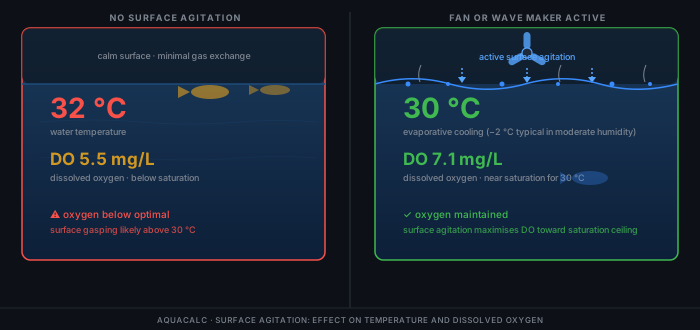
Left: still water surface, suboptimal DO, fish congregating at the surface. Right: active agitation from a fan or wave maker drives dissolved oxygen toward saturation and lowers temperature through evaporation.
Fans across the water surface — high confidence (physics), moderate confidence (magnitude)
A fan directed across the water surface causes evaporative cooling. As water molecules at the surface evaporate, they carry latent heat with them (approximately 2,260 kJ/kg — the latent heat of vaporisation of water). This is the same mechanism that cools your skin when sweat evaporates.
The effect is physically real and measurable. Hobbyist reports of 2–4 °C reductions are plausible and consistent with the physics, particularly in dry climates or well-ventilated rooms. The magnitude depends strongly on ambient humidity: evaporative cooling is most effective in dry air (low relative humidity) and less effective in humid conditions above 70–80% RH. During a typical UK summer heatwave, humidity is often moderate (40–60% RH), meaning fan cooling is effective but not as dramatic as in, for example, Mediterranean climates.
The trade-off is significant water loss — a fan running over a tank for 24 hours can evaporate several litres. Top up with dechlorinated water (not salt water, not unmixed RO) to prevent salinity and hardness creep.
Frozen water bottles — plausible, anecdotally reported
Floating sealed frozen bottles in a tank works by absorbing heat through the phase change of ice to water (latent heat of fusion: approximately 334 kJ/kg) and then as conduction from the surrounding water to the colder liquid inside as it warms. The physics is valid — ice absorbs substantial heat as it melts.
However, there is no formal published research on this in aquarium contexts, and there are important caveats:
- Introducing frozen bottles causes a localised, sharp temperature gradient in the tank. Fish near the bottle may experience a rapid temperature drop of several degrees, which itself is stressful. The rate of temperature change matters as much as the absolute temperature.
- The capacity of a 1.5 L bottle is limited — melting a 1.5 kg ice bottle absorbs approximately 500 kJ, enough to drop a 200 L tank by roughly 0.6 °C in theory. Repeated rotations of multiple bottles can produce meaningful cooling, but this requires forward planning.
- Do not add ice or cold water directly to the tank. This causes rapid temperature and chemistry changes (tap water may be untreated; ice made from tap water is not dechlorinated and has variable mineral content).
Verdict: physically sound, practically useful with care, but not a substitute for airflow and surface agitation. Use sealed bottles only, rotate frequently, and monitor temperature carefully.
Turn off or reduce lighting — high confidence
Any light source adds heat to the system, either directly to the water or to the surrounding air. During a heatwave, reducing the photoperiod (or eliminating lighting entirely for a day or two) removes one controllable heat source. The plants will not be harmed by two or three days of darkness; most will simply slow growth. Turn off lights at the first sign of heat stress and do not run them during the hottest part of the day.
Conversely: avoid supplemental room lighting (floor lamps, etc.) positioned near the tank, and ensure external blinds or curtains block direct sunlight from reaching the aquarium. Direct solar radiation can heat a tank surface at rates that dwarf any cooling strategy.
Reduce feeding — high confidence
Digestion is metabolically expensive. Feeding fish during a heatwave increases their oxygen demand (specific dynamic action — the metabolic cost of processing food) and generates more ammonia through protein catabolism. During a heat event, reducing feeding to once per day or stopping for 24–48 hours reduces both oxygen demand and ammonia load. Fish will not suffer from a brief fast; most healthy adults can go a week without food without harm.
Water changes with slightly cooler water — useful, but caution required
A partial water change (20–30%) using water that is a few degrees cooler than the tank can help lower temperature gradually. The operative word is gradually. A sudden temperature change of more than 3–4 °C in a short period causes thermal shock — the fish equivalent of jumping into a cold plunge pool. This stresses the immune system, can trigger disease outbreaks, and may cause direct physiological harm.
If using cooler water changes, aim for water that is 2–3 °C below the current tank temperature. Do not use very cold tap water or chilled water in one large dose. Spreading smaller top-ups over several hours is safer than a single large, cold change. Sensitive species — Caridina shrimp, discus, and small nano fish in particular — can react to temperature changes as small as 1–2 °C if they happen quickly; go more slowly with these animals.
Air conditioning — most effective, unambiguous
If air conditioning is available, this is the most reliable solution. Lowering the room temperature removes the driving force behind the tank warming. There is no trade-off, no risk of temperature shock, and no ongoing intervention required. Running a portable AC unit in the same room as your tank during a multi-day heatwave is the single most effective thing you can do if cost and access permit.
Aquarium chillers — effective, significant cost
Dedicated aquarium chillers are refrigeration units designed for exactly this purpose. They are expensive (£200–£1,000+ depending on tank volume) and consume significant power, but they are the only active solution that reliably maintains a set target temperature regardless of ambient conditions. For serious planted tank setups, high-value shrimp tanks or fishrooms, a chiller is the correct long-term answer.
Part five: CO₂-injected tanks during a heatwave
Running CO₂ injection adds a layer of complexity during extreme heat that is worth addressing directly, because the standard heatwave advice and the standard planted tank advice can work against each other.
CO₂ degasses faster as temperature rises
CO₂ solubility also follows Henry’s Law — the same physics that reduces dissolved oxygen at high temperature also causes injected CO₂ to leave solution more readily. At 32–34 °C, your CO₂ will degas faster than at your normal 25 °C, so even with the same injection rate your drop checker will likely show less CO₂ than usual. Plants may respond with stalling growth, partial leaf closure, or in a sustained heatwave, some deterioration at sensitive new growth tips. This is expected and recoverable.
Increased surface agitation — which is the most important intervention for your fish — accelerates CO₂ loss further. This is the central tension for planted tank keepers during a heatwave: the intervention that keeps fish alive actively degrades CO₂ availability for plants.
Do not turn CO₂ off suddenly
This is important. If you shut off CO₂ injection abruptly during a heatwave, two things happen:
- pH rises sharply. In a CO₂-injected tank, dissolved CO₂ forms carbonic acid (H₂CO₃) which keeps your pH suppressed. When CO₂ stops, carbonic acid disappears, and pH can rise by 0.5–1.0 units or more within hours. At elevated temperature, this pH rise further shifts the NH4+/NH3 equilibrium toward the toxic free ammonia form (as described above), compounding the chemical stress on fish at exactly the wrong moment.
- Plants experience a sudden shift. CO₂-dependent plants that have been in a stable injected environment will react to an abrupt cutoff, particularly if the tank is already thermally stressed. This adds plant stress to fish stress simultaneously.
If you need to add an airstone as an emergency oxygenation measure, do so — fish oxygen takes absolute priority — but accept that CO₂ will drop significantly while the airstone runs. Reduce injection rate rather than turning it off entirely if your system allows it.
Practical steps for CO₂ tanks during heat
- Monitor pH more frequently. Higher temperature, more surface agitation and faster CO₂ degassing will all push pH upward simultaneously. Your pH will be less predictable than normal. Log sessions with the AquaCalc pH Monitor to watch for unexpected pH spikes or drops, and use the parameter log to track readings across days so drift is visible. If you use a pH controller with a probe, be aware that it may increase CO₂ injection to chase a rising pH setpoint; at high temperature this relationship becomes less linear, so check your drop checker alongside pH readings.
- Do not increase CO₂ injection rate significantly without careful pH monitoring. The temptation to “compensate” for faster degassing by running more CO₂ is understandable, but higher temperature changes how CO₂ behaves in water. Increasing your solenoid on-time without watching actual pH can push you into unsafe territory unexpectedly.
- Accept reduced plant performance for the duration. A few days of reduced CO₂ will not kill established plants. Algae may opportunistically increase if CO₂ instability is prolonged, but this is manageable after the event. Your livestock cannot recover from hypoxia; plants typically can recover from a brief CO₂ deficit.
- Resume normal CO₂ gradually after the heatwave. Do not jump straight back to maximum injection rate once temperatures normalise. Reintroduce CO₂ over a day or two, watching pH, to avoid a sharp pH drop after the tank has been at a higher pH baseline.
- Check your plants in the days after. Some tip melt or leaf loss may occur at sensitive growth points. Trim affected tissue promptly to prevent rot spreading. This is cosmetic damage, not a systemic problem, unless temperatures remained dangerously elevated for many days.
Part six: what to avoid
- Rapid temperature changes in either direction. The rate of change is as dangerous as the absolute temperature. Both rapid heating and rapid cooling (from over-enthusiastic ice bottle use or cold water changes) stress fish acutely.
- Overstocking during heat events. More fish = more oxygen demand and more ammonia at a time when the system is already under pressure. If you have spare tanks, consider temporarily reducing stocking density.
- Covering the tank tightly. Lids trap warm air and prevent surface evaporation. During a heatwave, remove lids or open them fully — the cooling benefit of surface evaporation outweighs the risk of fish jumping for most species. Use a net cover if jumping is a concern.
- Adding salt as a general stressor remedy. Sodium chloride is sometimes recommended for fish stress, but during a heatwave it is counterproductive: it raises osmotic pressure, which increases the energy (and oxygen) fish need to regulate their body chemistry. Unless dealing with a specific disease requiring salt treatment, avoid this during a heat event.
- Turning off the filter. Filters remove waste and host the nitrifying bacteria; they also create water movement. Never turn the filter off during a heatwave, even if the pump motor adds some heat — the bacterial and movement benefits far outweigh the heat contribution.
The honest limits of hobbyist intervention
It is worth being direct: in a sustained multi-day UK heatwave with outdoor temperatures above 35 °C, an uncontrolled room without air conditioning will reach temperatures that put livestock at serious risk. Fans and ice bottles can mitigate; they cannot fully substitute for ambient temperature control. A room at 33 °C will produce a tank at roughly 30–32 °C even with aggressive intervention. For cold-water fish or sensitive invertebrates (Caridina shrimp, fancy goldfish), this is potentially lethal territory.
This is worth planning for before the heat arrives. The UK Climate Change Committee projects significantly more frequent and intense heat events for the UK through the 2030s and 2040s. A heatwave in 2024 or 2025 is no longer an anomaly. Decisions about stocking — how many fish, which species, how many shrimp — are increasingly decisions that carry a thermal risk component.
- Maximise surface agitation immediately — airstone, spray bar, powerhead at the surface.
- Remove the lid or open it fully. Block direct sunlight from the tank.
- Turn off lights. Turn off any non-essential electrical equipment in the tank.
- Stop or reduce feeding for 24–48 hours.
- Add a fan directed across the water surface.
- Monitor temperature every few hours. If above 30 °C, begin rotating sealed frozen bottles cautiously.
- Do small, slightly cooler water changes if the temperature is still climbing — 2–3 °C cooler than tank, 20–30% maximum, spread over several hours. Go more slowly with sensitive species (shrimp, discus).
- If you run CO₂ injection: do not turn it off suddenly. Reduce rate if needed, monitor pH closely, and accept that CO₂ efficiency will be reduced while surface agitation is running. See the CO₂ section above.
- If the tank exceeds 32–33 °C sustained and fish are showing stress signs, consider emergency relocation of the most sensitive livestock to a cooler space with portable cooling.
- Watch shrimp as your early warning system.
Related reading
- Water changes: what the science says — relevant to safe water change technique during heat events
- Comammox and the nitrogen cycle — understanding filter biology and why heat affects it
- CO₂ stability — why surface agitation and heat affect CO₂ levels in planted tanks
- Aquarium heat forecast — 14-day temperature forecast with Good / Warming / Extreme risk indicators for your location
Get a weekly aquarium weather look-ahead
Every Sunday at noon we send a short email showing the 7-day outdoor temperature forecast for your area, with risk levels calibrated to aquarium stress thresholds — Good, Warming, and Extreme. You'll know in advance whether the week ahead is a quiet one or a heatwave to prepare for.
What you get
A weekly 7-day forecast for your location, with risk levels tuned to the temperatures that actually affect fish and invertebrates. Signing up also adds you to the AquaCalc newsletter — you can unsubscribe from either independently, any time. No marketing, no sponsors.
Signs you up for the AquaCalc newsletter and the weekly weather look-ahead. Double opt-in — unsubscribe from either independently, any time.
Get your 7-day aquarium forecast
Every Sunday at noon — outdoor temperatures with aquarium risk levels for your location. Signs you up for the newsletter too; unsubscribe from either independently.
Comments
Add yoursNo comments yet — be the first to share your experience.