Amazon Sword: the plant that started planted tanks
The broad-leafed rosette from South America that has held its place as the hobby's defining background plant for six decades — easy to keep, structurally dominant, and one of the few plants that genuinely benefits from being in the substrate.
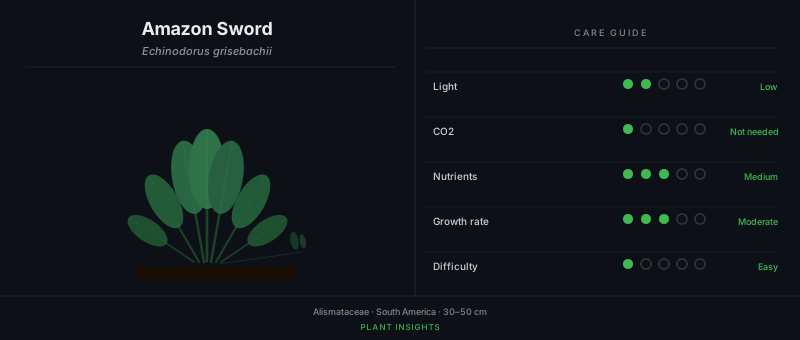
Where Amazon Sword comes from
The plant sold in aquarium shops as "Amazon Sword" is most commonly Echinodorus grisebachii 'Bleherae' (named after the ichthyologist Heiko Bleher, who collected it). It belongs to the family Alismataceae and is native to the river systems of tropical South America — primarily Brazil, Bolivia, Peru, and Paraguay. In the wild it grows along the shallow margins and floodplains of the Amazon basin, where it experiences dramatic seasonal variation: months of full submersion during wet season, then partial emergence or complete exposure as water levels drop in the dry season.
This amphibious lifestyle is why aquarium shops often sell Amazon Sword with emersed (above-water) leaves — the plant adapts readily to either condition. Emersed leaves are typically broader, thicker, and paler than submersed growth. When placed in an aquarium, those above-water leaves will usually yellow and die back within a few weeks. This is completely normal and not a sign of poor health; the plant is simply replacing its terrestrial leaves with aquatic ones. Do not remove healthy green growth prematurely — let the plant do this at its own pace.
What to expect
The Amazon Sword is a rosette plant — all its leaves emerge from a central crown rather than from a stem. Each leaf consists of a long petiole (stalk) topped with a broad, oval blade that can reach 15–20 cm in length and 4–6 cm in width. A mature plant in good conditions can have 20–30 leaves and spread 40–60 cm in diameter, making it a dominant specimen in any tank it grows in.
Growth rate is moderate to fast under good conditions — one to two new leaves per week. In a tank with CO₂ supplementation, strong light, and a nutrient-rich substrate, growth accelerates noticeably. At optimal temperature (24–28°C) the plant reliably sends out long horizontal runners with attached plantlets, which is how it propagates naturally.
How to keep it
| Parameter | Value |
|---|---|
| Lighting | Low to medium — 30–80 µmol/m²/s PAR; grows in dim tanks but thrives in moderate light |
| CO2 | Not required; benefits from supplementation but not dependent on it |
| Temperature | 22–28°C (tolerates 18–30°C) |
| pH | 6.5–7.5 |
| Hardness | Soft to moderately hard (2–15 dGH) |
| Fertiliser | Primarily root-fed — root tabs essential in inert substrates; liquid fertilisers supplement water column |
| Substrate | Nutrient-rich or supplemented with root tabs; minimum 5–7 cm depth for root development |
| Growth rate | Moderate — 1–2 new leaves per week under good conditions |
Amazon Sword feeds through its roots
Unlike Java Fern, Java Moss, or Anubias — which absorb nutrients through their leaves — the Amazon Sword is a heavy root feeder. In an inert substrate (plain gravel or sand), it will grow slowly and show deficiencies regardless of how much liquid fertiliser you dose. Root tabs placed near the roots every 3–4 months make a larger difference than any other single change. In an active substrate (aquasoil, or substrate mixed with clay/laterite), root tabs are less critical but still beneficial as the plant matures.
Where it works best
Amazon Sword is unambiguously a background or midground plant for larger aquariums. In a tank smaller than 100 litres, it will eventually fill the entire visual field; it is one of the few plants in the hobby that can genuinely outgrow a standard 60-litre tank. In appropriately sized setups — 120 litres and above — it works as a dominant centrepiece against the back glass, or placed off-centre as a structural anchor with lower-growing plants around its base.
Given enough space, the plant sends out long runners at water or substrate level, producing small plantlets at intervals. Once a plantlet has at least 4–5 leaves and its own visible roots (usually after 4–8 weeks), it can be separated from the runner and planted independently. Cut the runner cleanly close to the parent plant; the remaining stub will not harm it.
Keeping it tidy
Amazon Sword leaves do not live forever. Older outer leaves gradually yellow and die back, which is a normal part of the plant's growth cycle — it continuously produces new leaves from the centre while discarding older outer ones. Remove dying or dead leaves at the base using scissors, cutting as close to the crown as possible without damaging it. Never pull leaves out by hand; the petiole base is attached securely enough that pulling risks tearing the crown.
In tanks with aggressive algae, the broad flat surface of Amazon Sword leaves is a prime colonisation target for spot algae (green dots) and staghorn algae. Increasing CO₂ consistency and reducing excess light exposure helps. Physically removing algae with a soft cloth or toothbrush during water changes is effective; liquid treatments that touch the leaves directly are generally safe for the plant but should be applied with care around other tank inhabitants.
What goes wrong
Yellow leaves with green veins (iron chlorosis). The most common deficiency in Amazon Sword. The veins remain green while the blade between them turns pale yellow or white. Caused by insufficient iron in the substrate or water column. Dose a liquid iron supplement and, if the substrate is inert, add root tabs near the base of the plant. New leaves should show improvement within 2–3 weeks.
Holes in leaves (potassium deficiency). Small translucent patches on the blade that eventually become holes, often starting at the leaf margins. Potassium is the most commonly depleted macro-nutrient in established tanks. Dose a dedicated potassium supplement or a balanced macro fertiliser.
Slow growth and pale colour despite fertiliser. Usually indicates root starvation in an inert substrate. Liquid fertiliser alone is insufficient for a heavy root feeder — install root tabs within 5–8 cm of the crown and reassess after 4–6 weeks.
Emersed leaves yellowing after purchase. Normal and expected. The terrestrially grown leaves from the shop are being replaced by aquatic ones. Allow the transition to happen naturally; new submersed growth emerging from the centre confirms the plant is healthy.
More plants in this series
- Anubias barteri var. nana — the indestructible epiphyte
- Cryptocoryne wendtii — rosette, runner, survivor
- Vallisneria spiralis — the original background plant
- Rotala rotundifolia — the colour-shifting stem plant
- Eleocharis parvula (Dwarf Hairgrass) — the carpet that tests patience