Cryptocoryne wendtii: rosette, runner, survivor
Cryptocoryne wendtii has a reputation for drama. Move it, change the water chemistry, raise the lighting — and the leaves melt away within days. That reputation is mostly undeserved.
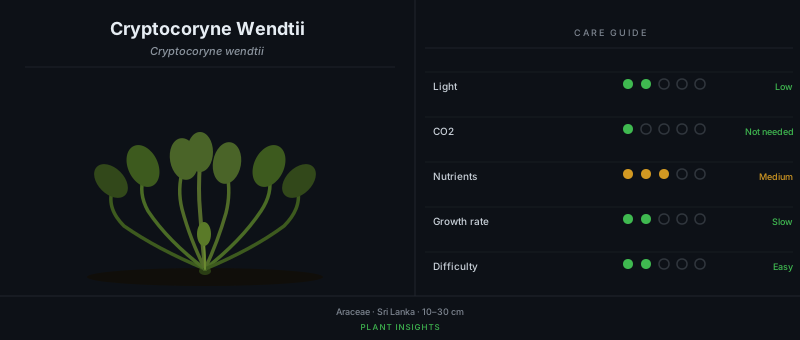
A plant built for seasonal extremes
Cryptocoryne wendtii is endemic to Sri Lanka, where it grows in clear, shallow rivers and streams from the lowland wet zone through to the intermediate zone. Sri Lanka's climate is driven by two monsoon seasons, and the rivers that Crypts inhabit can drop dramatically in dry periods — sometimes exposing the plants to air entirely. C. wendtii grows in both submerged and emersed forms, and this amphibious lifestyle is central to understanding its behaviour in the aquarium.
The water it inhabits is typically soft, moderately acidic (pH 6.0–7.0), and relatively low in nutrients. Substrate is usually sand or fine gravel over clay-rich soil — which is why wendtii is a heavy root feeder compared to many other aquarium plants.
What to expect
Cryptocoryne wendtii is a rosette plant — leaves grow in a spreading crown from a central stem. The leaves are elongated, slightly wavy along the margins, and taper to a point. Their colour is one of the genus's most variable traits: in low light wendtii tends toward mid- to olive-green; with brighter light and richer substrate it can develop rich brown, bronze, or reddish tones. Leaf surface texture varies from smooth to slightly bullate (puckered).
Commonly available cultivars include:
- 'Green' — the base form; reliable, mid-green, suited to almost any setup
- 'Brown' — warm brown to olive; particularly attractive in lower light
- 'Red' — burgundy under good light; needs moderate lighting to hold colour
- 'Mi Oya' — narrow, elongated leaves; a distinct-looking form from the Mi Oya river
How to keep it
| Parameter | Value |
|---|---|
| Lighting | Low to medium — 15–50 µmol/m²/s PAR |
| CO2 | Not required; improves growth speed and colour if added |
| Temperature | 22–28°C |
| pH | 6.0–7.5 |
| Hardness | Soft to moderately hard (2–15 °dH) |
| Fertiliser | Medium; root tabs or nutrient-rich substrate strongly beneficial |
| Substrate | Fine-grained; nutrient-rich substrate improves colour and vigour |
| Growth rate | Slow to moderate — 2–4 new leaves per month once established |
Wendtii is primarily a root feeder. It will grow in inert sand or gravel, but it does so slowly and without much colour. Planting into a nutrient-rich substrate — or supplementing with root tabs positioned near but not touching the crown — makes a significant difference to growth rate, leaf size, and colour development.
What crypt melt is — and is not
Crypt melt is the rapid decay of leaves following a change in conditions. It most commonly happens when a plant is moved from one tank to another, when water chemistry changes significantly, when lighting is substantially increased, or when a plant transitions from emersed to submersed growth (as is common with commercially-grown stock).
The important thing to understand is that crypt melt is a leaf response, not a plant death. The root system and crown usually remain intact and healthy. Remove the melted leaves, maintain stable conditions, and new growth almost always follows within 2–4 weeks. The new leaves are typically well-adapted to the tank's specific conditions, and the plant establishes quickly from that point.
Preventing melt
The most reliable way to minimise melt is to make any transition gradual. Float the plant in its destination tank for a few days before planting. If raising light levels, do so in increments over 1–2 weeks rather than all at once. Stable water temperature and chemistry during the establishment period matter more than ideal values.
For more detail on why aquarium plant leaves deteriorate under stress, see our article on why aquatic plants melt and how to prevent it.
Where it works best
Wendtii is a classic mid-ground plant in tanks 40 cm or taller. Its spreading rosette habit means individual plants need 10–15 cm of space around them to develop fully. Plant in groups of 3–5 for a natural look, staggering the sizes. In low-tech setups without CO2, it is often the most attractive mid-ground option available — tolerant of the conditions, slow enough to avoid constant maintenance, and visually interesting in a way that purely green plants are not.
Runners and division
Once established, wendtii sends out runners — horizontal stolons at substrate level — that produce daughter rosettes. Allow daughters to develop 3–4 leaves of their own before detaching. Simply cut the runner and replant the daughter. A single established plant can produce 4–6 new plants per year under good conditions.
More plants in this series
- Anubias barteri var. nana — the indestructible epiphyte