Do you really need to acclimatise new fish? What the science says
One keeper nets their fish straight in; another drips for 45 minutes. Both swear by their method — and both usually work. Here is the physiology that explains why, and how much change a fish can actually take.

Two keepers, two methods, both work
Ask ten aquarists how to add new fish and you will get two camps. One floats the sealed bag for a few minutes to match temperature, nets the fish out, and lets them go — done in five minutes. The other spends 30 to 45 minutes slowly dripping tank water into a tub, doubling and re-doubling the volume before the fish ever touch the display. Each camp is convinced the other is doing it wrong. And here is the awkward part: both methods usually work.
That should bother us. If a 45-minute ritual were truly necessary, the plop-and-drop crowd would be leaving a trail of dead fish — and they are not. If it were pointless, the drip crowd would have noticed. The only way both can be right is if acclimatisation is protecting against something specific, and that something is sometimes present and sometimes absent. So the useful question is not “how long should I acclimatise?” but “what is acclimatisation actually protecting the fish from, and is that threat even present in my case?”
The one idea that unlocks the whole topic
“Acclimatisation” is not one thing. A fish moving from bag to tank faces three separate changes — temperature, dissolved-ion concentration, and the chemistry of the bag water itself — and each has different physiology, a different tolerance, and a different answer. Treat them separately and the contradiction dissolves.
The transition you can almost never skip — and the easiest to fix
Fish are ectotherms: they do not regulate their own body temperature, so their entire metabolism — heart rate, gill function, enzyme activity, immune response — runs at whatever temperature the water is. Drop a fish adapted to 25 °C into 20 °C water and every one of those systems lurches at once. The gill epithelium, the fish’s most delicate and metabolically active tissue, is especially sensitive to an abrupt swing.
How much can they take? More than the hobby fears, but the rate matters more than the size. The upper lethal limits (the critical thermal maximum) for common tropical aquarium fish sit well above normal keeping temperatures — a few degrees is not going to kill a healthy fish. Thermal tolerance is also plastic: acclimate a tropical freshwater fish to warmer water and its tolerance shifts upward over days. But that plasticity takes time. An instantaneous 4–5 °C jump gives the fish no chance to adjust, and even when it is survivable it is a measurable stressor that can dampen immune defences exactly when a new fish can least afford it.
The good news is that this is the cheapest transition to neutralise. Floating the sealed bag in the tank for 15–20 minutes closes most of the gap with zero effort (a large bag with a big temperature difference needs longer). That is why even “I don’t acclimatise” keepers almost always still float the bag: even if your shop water is chemically identical to yours, the bag has been warming or cooling in a car or on a shelf, so a temperature gap almost always exists. Temperature is the one you should equalise essentially every time, precisely because it is so easy.
What “chemistry shock” really means — osmoregulation
This is the change the drip method is really built around, and to understand it you have to know one thing about freshwater fish: their blood is far saltier than the water they live in. A freshwater fish holds its internal salt concentration at roughly a quarter to a third of seawater, while the water around it is nearly pure. Physics therefore works against it constantly — water floods in by osmosis and precious ions leak out.
To survive, the fish runs a continuous, energy-hungry counter-pump. Its gills are studded with specialised cells (ionocytes) that actively drag sodium, chloride and calcium back in from the water, while its kidneys pour out vast quantities of dilute urine to bail out the incoming water.1 This machinery is calibrated to the total concentration of dissolved ions — dominated by sodium and chloride, which is exactly why GH (calcium and magnesium only) is only a partial guide, and your overall TDS/conductivity is the better proxy for the load a fish actually feels.
Move the fish suddenly to water with a very different ion concentration and the calibration is wrong. If the new water is much softer (fewer ions), the gill pumps cannot grab ions fast enough and the fish starts losing the internal-salt battle; if much harder, the balance tips the other way. The fish can re-tune — it up- or down-regulates those gill transporters — but that takes hours, not seconds. A large, instantaneous jump in dissolved-ion concentration is a genuine osmotic stressor.
Which number matters?
The osmotic stress tracks the change in total dissolved ions — roughly, your GH and overall TDS. A jump from very soft to very hard water (or vice-versa) is the real event. KH matters mainly indirectly, through its effect on pH stability, rather than as a major osmotic load in its own right. So “my GH is 7 and theirs was 20” is worth acclimating for; “my KH is one degree different” is not, on its own.
pH, and the ammonia trap that makes a long, slow drip risky
Here is the part almost no one explains — and the key to why, in one specific situation, a longer acclimatisation can backfire.
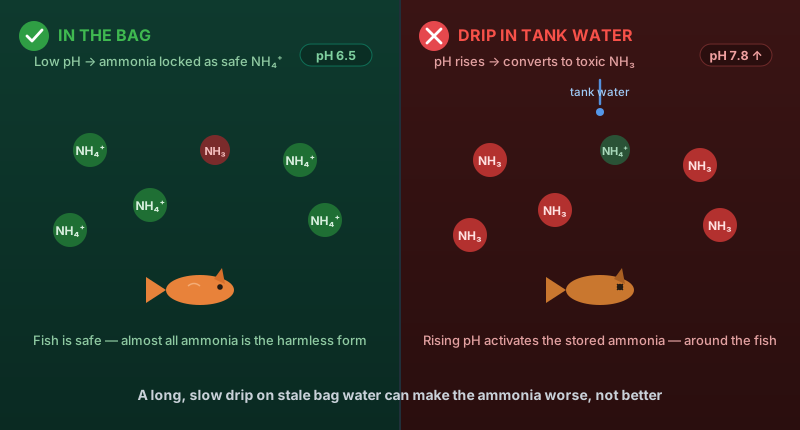
From the moment a fish is bagged, two things build together: it keeps excreting ammonia, and its respiration loads the water with carbon dioxide. That CO2 forms carbonic acid, so the bag water tends to acidify — though how far depends on the water’s buffering (its carbonate hardness, KH). Soft, poorly-buffered shipping water can drift down by a pH unit or more over a long journey; well-buffered water barely moves.3 This matters because ammonia exists in two forms in a pH-dependent balance: toxic, un-ionised ammonia (NH3) and relatively harmless, ionised ammonium (NH4+). The un-ionised form is roughly a hundred times more toxic to fish than the ionised form.2
The split between them is governed mostly by pH (and, to a lesser degree, temperature): the higher the pH, the greater the fraction sitting in the toxic NH3 form — changing by roughly an order of magnitude for each unit of pH near neutral.4 So inside a bag that has gone acidic, the fish is often surprisingly safe: the low pH keeps almost all of the accumulated ammonia locked away as non-toxic ammonium.
“The bag is a loaded gun with the safety on. The low pH is the safety catch — and raising the pH is what pulls the trigger.”
Now watch what a slow drip does to a bag that has been sealed long enough to load up. Your tank water is almost certainly higher in pH than the stale bag water, so as you drip it in you raise the pH around the fish — and every step up converts more of that stored ammonium into toxic ammonia, right at the gills. A long, slow drip maximises the time the fish spends marinating in its own now-activated waste. That is the counter-intuitive heart of it: for a fish that has been in the bag a while, the most protective thing you can do is get it out of that water quickly — not spend an hour slowly poisoning it.
Crucially, this only bites at the long end of the scale, and the transport-stress literature says exactly that: on short journeys the main water-quality risk is the modest pH drop, while it is the steady build-up of ammonia that dominates on long ones — and either way, sealed-bag conditions put a hard ceiling on how long fish can safely stay in there (commonly around a day, though it varies with stocking density, temperature and whether the bag was oxygen-packed).3
How real is the trap? It depends almost entirely on how long the fish was bagged. It needs two things to line up — enough ammonia to have accumulated, and a bag acidic enough to be holding it as ammonium — and both build with time.
- The drive home from the shop (say two hours). Six small tetras in half a litre of water excrete only a trace of ammonia in that time — of the order of a couple of hundredths of a mg/L5 — and in normally-buffered water the pH has barely shifted. There is almost nothing stored, and almost no pH gap with which to unlock it. If a fish is lost after a short hop like this, the ammonia trap is rarely the reason: temperature shock, a real ion/pH gradient from very different water, or a fish that was already ailing in the shop are all far likelier.
- An overnight or courier shipment (12–48 hours). Now the same fish may have pushed total ammonia up toward a few tenths of a mg/L, and in soft, low-KH water the pH can have fallen to around 6.5. At that pH and 25 °C only about 0.2% of the ammonia sits in the toxic NH3 form,4 so the fish is riding it out. Lift that water to a typical tank pH of 7.8 and the toxic fraction climbs to about 3.4% — a roughly twenty-fold jump — without a single extra molecule of ammonia being made. That is the trap, and it is why a leisurely, pH-raising drip on a long-shipped bag is the one thing you don’t want to do.
So why do both methods work?
Put the three changes together and the contradiction disappears. Both camps are right — each within their own conditions.
- When the gap is small, plop-and-drop wins. If you buy from a shop whose water is similar to yours, on a short trip, and you float the bag to match temperature, then there is almost nothing left to bridge. The ion gradient is tiny, the pH gap is small, and the bag has not been sealed long enough to load up with ammonia. Netting the fish straight in is not just acceptable — it is arguably better, because it gets them out of the bag fastest. This is the 40-minutes-from-the-shop, same-water scenario, and the science is on the quick-transfer side.
- When the gap is large, a bridge helps — but only up to a point. If the fish are coming from very different water after a long journey, the ion and pH gradients are real, and easing them over a few minutes genuinely reduces osmotic and pH shock. But the ammonia trap caps how much slow is good: past a certain point you are converting stored ammonium to ammonia faster than you are helping. A brief, bounded drip captures the benefit; an open-ended one starts to cost.
- Fish are better buffered than the ritual implies. Because they are active regulators — constantly re-tuning gill pumps and metabolism — healthy fish tolerate moderate step changes far better than folklore suggests. The enemy is the large, instantaneous change and prolonged exposure to bad water, not the mere fact of change.
In other words, the two methods are not really rivals. They are answers to two different situations, and the mistake is applying either one universally — dripping for an hour when there is nothing to bridge, or plopping fish from wildly different water straight into the tank.
How much change can a fish actually handle?
There is no single threshold — tolerance depends on the species, its health, and how fast the change happens. But here is an honest, rule-of-thumb picture of what matters, and roughly how much. Treat these as guidance for judging your situation, not lines that flip from safe to fatal.
| What changes | Rough “bridge it” threshold | What’s really going on |
|---|---|---|
| Temperature | Equalise essentially always; avoid sudden swings beyond ~2–3 °C | Ectotherm metabolism tracks water temp; rapid swing stresses the gills and immune system. Cheapest to fix — just float the bag. |
| Total ions (GH / TDS) | Bridge if it is a big jump (e.g. very soft ↔ very hard) | The true osmotic load. Gill ion-pumps must re-calibrate; a large instant change is the real “chemistry shock”. |
| pH | Bridge large gaps (>~0.5–1.0 unit); mind the ammonia link | Fish tolerate a wide steady pH; danger is sudden large swings and the ammonia conversion in bag water. |
| KH | Rarely worth acclimating for on its own | Matters mostly as pH stability, not as a direct load on the fish. |
| Ammonia in the bag | Get them out promptly; never raise pH slowly over stale bag water | Low bag pH keeps it as safe NH4+; raising pH converts it to toxic NH3. Time in the bag is the enemy. |
Two honest caveats. First, species matter: hardy livebearers and danios shrug off changes that a soft-water wild-caught fish (some tetras, wild bettas, many rasboras) would feel keenly — the more specialised the fish, the more a genuine gradient is worth bridging. Second, if you do not know the source water, err toward a short, gentle bridge; the cost of a few minutes is trivial, and the point is to cover the case where the gap turns out to be large.
What to actually do
Here is the evidence-led protocol. It is deliberately shorter than the ritual you may have been taught, and that is the point.
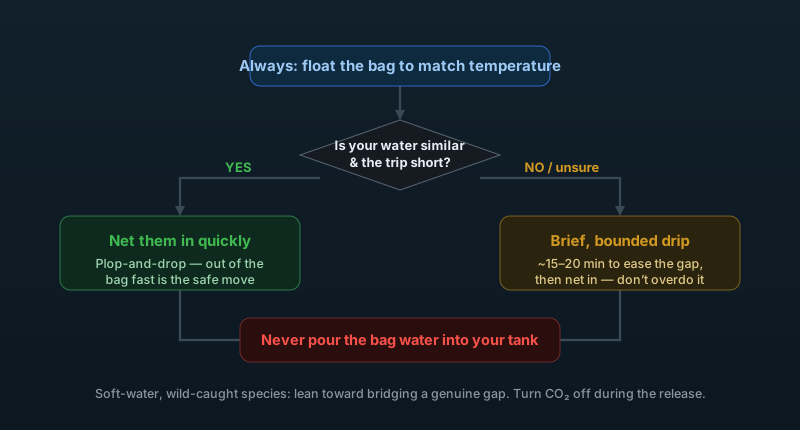
- Always match temperature. Float the sealed bag in the tank for 15–20 minutes. This is the one universal step.
- Then judge the chemistry gap. If you know your water is similar to the shop’s (or you use the same source, or the trip was short) — net the fish out and release them. Do not prolong it. Quick transfer out of the bag is the protective move.
- Only bridge a real gap. If the source water is very different or unknown, or the journey was long, do a brief, bounded drip — enough to ease a genuine ion/pH gradient, then net them in. There is no prize for stretching it past 15–20 minutes, and the ammonia trap means longer can be worse.
- Never pour the bag water into your tank. Always net the fish out and leave the bag water behind. It is a concentrated brew of ammonia, waste and whatever the shop tank carried — and this is also your first line of defence against importing disease. (Acclimatisation is not quarantine; if you want to protect an established tank from a new fish’s pathogens, that is a separate step, and a bigger subject — quarantine, and when it can be skipped.)
- Turn off CO2 while you release them. If you run pressurised CO2, switching it off for the release avoids adding a low-oxygen, low-pH moment to an already stressful one — especially in warm weather when water holds less oxygen.
The one-paragraph version
A new fish faces three changes, not one: temperature, dissolved-ion concentration, and the bag’s own chemistry. Always equalise temperature — it is easy and almost always needed. Bridge the ion/pH gap only when it is genuinely large; when your water matches the source, plop-and-drop is not laziness, it is the faster route out of the hostile bag. And on a long-shipped fish, beware the ammonia trap: a bag that has gone acidic keeps ammonia locked as safe ammonium, so slowly dripping in higher-pH tank water can convert it to toxic ammonia around the gills. Get them out reasonably quickly, never pour bag water in, and match the effort to the size of the real gap — not to a ritual.
None of this makes acclimatisation pointless — it makes it targeted. Understand the three changes and you can tell, for your fish and your water, whether you are the 40-minutes-away keeper who can net them straight in, or the long-haul keeper who should bridge the gap. Both of you are right; you are just answering different questions.
- Evans, D.H., Piermarini, P.M. & Choe, K.P. (2005). The multifunctional fish gill: dominant site of gas exchange, osmoregulation, acid–base regulation, and excretion of nitrogenous waste. Physiological Reviews, 85(1), 97–177. doi:10.1152/physrev.00050.2003 — the standard review of how fish gills run osmoregulation, acid–base balance and ammonia excretion.
- Randall, D.J. & Tsui, T.K.N. (2002). Ammonia toxicity in fish. Marine Pollution Bulletin, 45(1–12), 17–23. doi:10.1016/S0025-326X(02)00227-8 — establishes that un-ionised ammonia (NH3) is far more toxic than ionised ammonium (NH4+).
- Sampaio, F.D.F. & Freire, C.A. (2016). An overview of stress physiology of fish transport: changes in water quality as a function of transport duration. Fish and Fisheries, 17(4), 1055–1072. doi:10.1111/faf.12158 — documents the pH fall and ammonia rise in transport water, and how the dominant risk shifts from pH (short trips) to ammonia (long trips).
- Emerson, K., Russo, R.C., Lund, R.E. & Thurston, R.V. (1975). Aqueous ammonia equilibrium calculations: effect of pH and temperature. Journal of the Fisheries Research Board of Canada, 32(12), 2379–2383. doi:10.1139/f75-274 — the classic quantification of how the NH3/NH4+ split shifts with pH and temperature.
- Ip, Y.K. & Chew, S.F. (2010). Ammonia production, excretion, toxicity, and defense in fish: a review. Frontiers in Physiology, 1, 134. doi:10.3389/fphys.2010.00134 — reviews ammonia excretion rates and handling across teleost fish; routine rates for small freshwater species are of the order used here.
- Note on evidence: the underlying physiology here — osmoregulation, the ammonia equilibrium, transport-water chemistry — is well established. The specific protocols (exact float times, drip rates, durations) are practitioner conventions rather than conclusions from controlled acclimatisation trials on ornamental fish, which are scarce. They are presented as reasoned application of the physiology, not as separately proven procedures.
Comments
Add yoursNo comments yet — be the first to share your experience.