Essential aquascaping tools: the minimum kit that actually matters
Four tiers, from the tools you genuinely cannot work without to the ones you can improvise or skip entirely — and the one specification most guides never mention.

You need fewer tools than the photos suggest
Search for aquascaping tools and you will be shown a black case with fourteen shining instruments nested in foam. It looks serious and it photographs beautifully. In practice most people use three of them, lose two, and never work out what the other nine are for.
This guide is not a brand roundup and there are no product names in it. It answers a narrower and more useful question: what is the minimum set of kit that makes this job easy, and what can you skip? The answer sorts cleanly into four tiers, and once you see it that way, the fourteen-piece case stops looking like a bargain and starts looking like padding.
One framing note before we start. Almost nothing here rests on research. Tool choice in this hobby is craft practice — accumulated, widely-agreed, sometimes contested, but not measured. Where something is genuinely just consensus, this guide says so rather than dressing it up.
Day one: you cannot do the job well without these
Tweezers — the single highest-value tool
If you buy one aquascaping tool, buy tweezers. Nothing else changes the experience as much. Aquascaping tweezers (often sold as pinsettes) let you grip a single stem low down, push it into the substrate at an angle, and release it below the surface without your fingers following it in. Fingers are fine for a sword plant. For a tissue-culture portion the size of a match head, they are hopeless — you place the plant, withdraw your hand, and pull half of it back out with you.
They also matter for everything that is not planting: retrieving a dropped snail shell, positioning moss, feeding frozen food into a crevice, plucking a dying leaf from behind a rock. They become the general-purpose extension of your hand.
Length versus tank depth — the specification nobody mentions
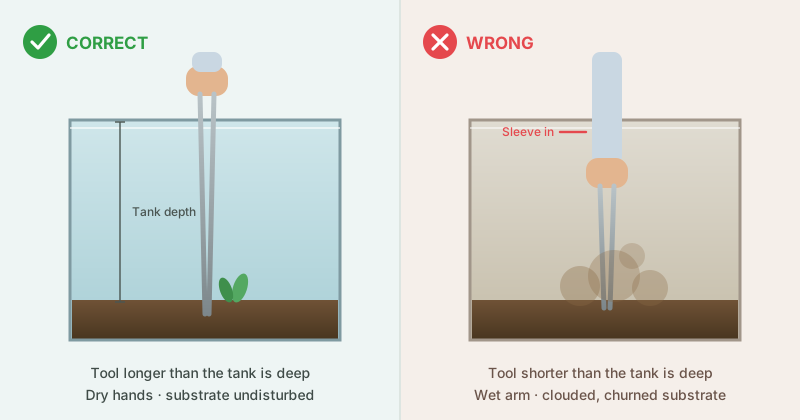
This is the one measurement that decides whether you enjoy using a tool or resent it. Your tweezers should be comfortably longer than your tank is deep — enough that when the tips are in the substrate, your fingers are still above the rim. As a rough working rule, add about 10 cm to the internal depth of the tank and buy at least that. A 45 cm tall tank wants roughly 45–50 cm tools, not the 27 cm pair that comes in most starter kits.
Get this wrong and two things happen, every single time. Your sleeve goes in the water, which is merely annoying. And your forearm and wrist go in with it, which is not — a submerged arm displaces water, drags across plants you have already placed, and stirs the top layer of substrate into a cloud you then cannot see through. The second half of a planting session with short tools is done half-blind.
Straight or curved?
Both shapes exist for real reasons, and neither is a luxury version of the other.
- Straight tweezers are the default. They give the most direct control for pushing stems down into substrate, because the force runs straight along the tool. If you are buying one pair, buy straight.
- Curved tweezers win wherever you need to work at a shallow angle: dotting carpet portions into the foreground, reaching under an overhanging rock or piece of wood, or planting close to the front glass where a straight tool makes you lean awkwardly over the tank. The curve lets your hand stay high and level while the tips stay low.
Practically: straight first, curved second, and if you are carpeting a foreground you will want the curved pair sooner than you expect.
Scissors
The other genuine day-one tool, for the simple reason that plants grow. Household scissors do cut, but they are short, blunt-tipped and made to be used above water; using them means putting your hand in and cutting blind.
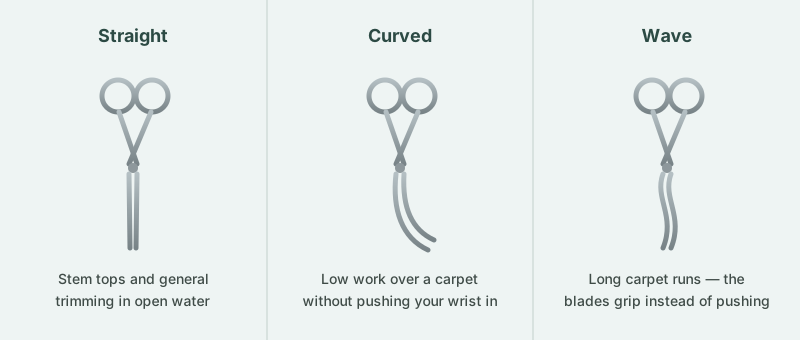
- Straight scissors handle the bulk of the work — topping stem plants, thinning a background, cutting runners. Buy these first.
- Curved scissors come into their own on carpets and low planting. The curve keeps the blade parallel to the substrate while your hand stays clear, which is exactly what you want when levelling a carpet without gouging it.
- Wave scissors have a wavy blade profile that grips stems instead of pushing them away. On a long carpet run or a dense mat, straight blades tend to shove the leaves aside and cut unevenly; wave blades bite. Genuinely useful on a big carpet, entirely unnecessary otherwise.
- Spring-loaded scissors reopen themselves after each cut, which reduces hand fatigue during a long trim. A comfort feature, not a capability.
One thing scissors are not is a substitute for judgement about what to cut. Where the damage sits is the clue. Older lower leaves yellowing while new growth stays green points one way; pale or deformed new growth above healthy old leaves points somewhere quite different. Either way the plant is often telling you something about nutrient supply rather than asking to be trimmed — which nutrients move within the plant and which do not explains why the pattern matters.
Water-change kit
The least glamorous item on the list and, by a wide margin, the most used. A siphon with a wide gravel-vac barrel, a length of hose, and a bucket or two will see more action than every other tool combined. Nobody photographs a bucket.
The gravel vac does two jobs at once: it moves water out, and it lifts settled detritus from the substrate surface while doing it. In a planted tank you generally hover it over the substrate rather than driving it in — you are removing loose organic debris, not excavating a rooted bed. That debris matters more than it looks; our guide to dissolved organics covers what accumulates and why exporting it is worth the effort, and the water-change guide covers volume and frequency. If you are on tap water, a dechlorinator belongs in this kit too — see chlorine and chloramine.
Two dedicated buckets, marked and never used for anything else, is the cheapest insurance in the hobby. Detergent residue in a bucket that once held floor cleaner is a real way to kill a tank.
“Long tweezers, decent scissors and a siphon will out-perform a fourteen-piece case every time. The rest is convenience.”
Worth adding early
Algae scraper or magnetic glass cleaner
Front glass films over. It happens in every tank, and it is the difference between a scape that looks sharp and one that looks tired. A scraper on a handle costs very little and works well; a magnetic cleaner — two magnets, one inside and one outside — means you never put your arm in at all, which on a deep tank is a real gain.
Two cautions worth knowing. On acrylic tanks, use only pads sold as acrylic-safe: metal blades and grit will scratch it permanently. And on any tank, a magnetic cleaner that picks up a grain of sand will drag it across the glass in a long visible arc. Check the pad before each pass and keep it clear of the substrate line.
A scraper deals with the film. It does not deal with the cause — if you are fighting a specific outbreak, our black beard algae guide is a better starting point than a stiffer blade.
Turkey baster or large pipette
Absurdly cheap, absurdly useful, and rarely in anyone’s list. Its jobs: blowing detritus off leaves and hardscape so the filter can pick it up, spot-feeding shrimp or corydoras, spot-dosing liquid treatments where you want them, and lifting a small amount of debris out without starting a full siphon. If you buy one tier-two item, this is the one that punches hardest for the money.
Cyanoacrylate gel superglue
The standard method for attaching epiphytes — Anubias, Java fern, Bucephalandra, mosses — to wood and rock. Gel, not liquid — thin liquid runs and spreads before you can position the plant, where gel stays put long enough to place it. It cures on contact with water and is inert once set, which is why it is the hobby default. Thread works too and rots away on its own, but glue is faster and holds instantly. The mechanics of attaching a rhizome without burying it are covered in preparing and planting new plants.
A fine net
Not for catching fish, particularly — for skimming. Trimmings float. A fine-mesh net swept across the surface after a trim removes most of what you cut before it works its way into the filter or settles behind a rock and breaks down.
Nice to have
Substrate spatula or flattener
A flat blade on a long handle, used to level substrate, shape slopes and terraces, and tidy the sand-to-soil boundary. It does exactly what it claims and does it well.
Be honest about when it earns its place, though. If you are building a layered, contoured scape with a sand foreground meeting an aquasoil slope, a spatula gives a crispness that is hard to get otherwise — and it is far easier to use during the dry build than later. If your substrate is simply spread evenly across the base, a spatula is solving a problem you do not have; a clean plastic ruler or a straight-edged piece of card does the same job on a flat bed. It is the most skippable of the tools sold as “essential”. Substrate choice itself matters a great deal more than how neatly it is levelled — see substrate and nutrient holding.
Plant weights
Small soft strips wrapped around a stem to hold it down while it roots. Useful for buoyant stems in fine sand, and for holding a plant in position in flowing water. Mostly, though, floating stems are a technique problem rather than a weight problem: a stem pushed straight down and shallow will pop back out no matter what you tie to it. Fix the angle and the depth first.
Curved tweezers, a second pair
Listed in tier one as the shape, listed here as the second purchase. Nobody needs two pairs on day one. Once you are carpeting or planting around hardscape, you will want them.
Honestly skippable — and where improvising costs you
This is the section the fourteen-piece case does not want you to read.
- Sand flatteners, rakes and mini-shovels. Attractive, near-useless. A ruler, a spoon and a piece of stiff card cover the same ground.
- Most specialist “pruning” scissors. If you already own straight and curved, the additional shapes in a big set are variations you will not reach for.
- Dedicated tool cases and magnetic holders. Genuinely pleasant. Genuinely not a tool. A drawer works.
- Branded buckets and hoses. A hardware-shop bucket and a length of clear hose are identical to the aquarium-branded versions at a fraction of the price. This is a place where cheap is simply correct.
- Kitchen tongs and chopsticks instead of tweezers. Reported to work, and they do — for large rooted plants. For anything small they are too blunt to grip a single stem and too short for a deep tank. This is the improvisation that actually costs you: you will churn the substrate and place plants badly, and you will conclude the plants were the problem.
- Household scissors instead of aquascaping scissors. Fine occasionally on a shallow tank. On anything over about 35 cm deep you are cutting blind with your arm submerged, and blunt blades crush stems rather than slicing them, which leaves a ragged end that is slower to recover.
Why cheap steel is a false economy — and where it isn't
Tools that go in water need to be corrosion resistant. The stainless grades commonly used for aquascaping tools — the 304 and 316 families — contain enough chromium to form a passive oxide layer that resists rusting; 316 additionally contains molybdenum, which improves resistance to chloride attack and is the reason it is the usual choice for marine and saltwater use.1 That part is real metallurgy, not marketing.
Very cheap tools are often plated or made from a low grade that is stainless in name only. The failure sequence is predictable: a rust bloom appears at the tip or the pivot, it stains hardscape and silicone where it touches, the pivot stiffens, and the tool ends up in a drawer within a year. You then buy the tool you should have bought first. The corrosion itself is very unlikely to poison a tank — the quantity of iron involved is trivial — but a seized, staining, blunt tool is a bad tool.
Freshwater is much gentler on steel than saltwater, so 304-grade tools are entirely adequate for a planted freshwater tank; 316 is worth the difference if you keep marine or brackish. Whichever you buy, rinse in fresh water and dry after use. That single habit does more for tool life than the grade does.
Where cheap kit is genuinely fine
Buckets, hoses, siphons, turkey basters, nets, plant weights and glue have no meaningful quality tier — buy the cheap ones without a second thought. Spend the money on tweezers and scissors, which are the tools where grade, length and blade quality change what you can actually do. Everything else is a container or a tube.
If you want the whole thing in a paragraph
Buy one pair of straight tweezers longer than your tank is deep, one pair of straight scissors, a siphon, a hose and two dedicated buckets. Add a magnetic or handled glass cleaner, a turkey baster and a tube of gel superglue when you get round to it. Add curved tweezers when you start carpeting, curved scissors when you start trimming low, and a spatula only if you are building contours. Skip the rakes, the shovels, the branded buckets and the fourteen-piece case. Spend on the two tools that touch plants; be cheerfully cheap about everything else.
If you are still assembling a first setup, our tank kit planner works through the equipment side, and preparing and planting new plants covers what to do once the tools are in hand. The choice between formats when you buy — tissue culture versus potted plants — also affects how much tweezer work you are in for, since tissue-culture portions are small enough that fingers are not an option. And our plant profiles list placement and difficulty for each species, which is worth checking before you commit to a carpet.
- British Stainless Steel Association. Alloying additions in stainless steel — on the roles of chromium in forming the passive layer and of molybdenum in improving resistance to chloride-induced pitting, which is the basis of the 304 versus 316 distinction.
- Note on evidence. With the exception of the metallurgy above, essentially nothing in this article is drawn from peer-reviewed research, because none exists on the subject. Tool selection, tool length, blade shape and the tier ordering here are craft practice — the accumulated, broadly consistent experience of aquascapers and retailers, reported and re-reported until it reads like fact. It is good practical guidance and it is what experienced hobbyists do, but it has not been measured or tested, and reasonable people disagree at the margins (particularly about substrate spatulas and wave scissors). Treat it as informed consensus, not as a research finding.
Comments
Add yoursNo comments yet — be the first to share your experience.