Comammox: the bacteria
rewriting the nitrogen cycle
For a century, aquarium science held that two separate groups of bacteria were needed to process ammonia into nitrate. In 2015, a single organism was discovered that does both — and it may already be living in your filter.
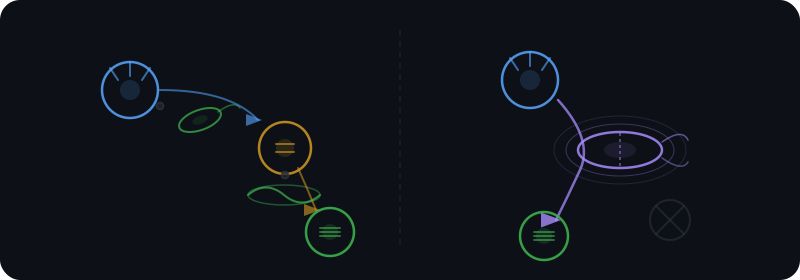
Every fishkeeper learns the nitrogen cycle early. Ammonia from fish waste is toxic. A group of bacteria called Nitrosomonas converts it to nitrite — also toxic, but less so. A second group, Nitrospira or Nitrobacter, converts nitrite to nitrate — relatively harmless at moderate levels. Two steps, two organisms, one cycle. This model has been taught in fishkeeping guides, on forum primers and in textbooks for decades.
In December 2015, two independent research teams published simultaneous papers in Nature describing an organism that performs both steps on its own — converting ammonia all the way to nitrate in a single organism, without releasing nitrite as an intermediate. They called the process comammox: complete ammonia oxidation.
The organism doing it was not some exotic newcomer. It was a strain of Nitrospira — a genus that aquarists already knew as the second-stage nitrite oxidiser. Some Nitrospira, it turned out, had never needed a partner at all.
How we thought nitrification worked
The classical view of nitrification divides neatly into two stages, each performed by a distinct group of specialists.
Ammonia-oxidising bacteria (AOB) — principally Nitrosomonas in freshwater systems — take ammonia (NH₃) and oxidise it to nitrite (NO₂⁻). This is the first and, in a new tank, rate-limiting step. It's also the reason a cycling aquarium produces the feared nitrite spike: Nitrosomonas populations establish faster than the nitrite-consuming organisms that follow them.
Nitrite-oxidising bacteria (NOB) — most commonly Nitrospira, though Nitrobacter also appears in some environments — take that nitrite and oxidise it to nitrate (NO₃⁻). In a well-cycled tank, this second stage processes nitrite as fast as it's produced, keeping levels undetectable.
This division of labour made thermodynamic sense. Each reaction releases a relatively small amount of energy; specialising in one step was presumed to be efficient enough. The idea that a single organism might run the whole sequence was considered theoretically possible as far back as the 1970s, but no organism demonstrating it had ever been found — until it was.
Nitrospira inopinata — and what makes it different
The two 2015 papers — Daims et al. and van Kessel et al., both published in Nature — described comammox activity in Nitrospira strains isolated from a drinking water distribution pipe and a freshwater enrichment culture respectively. The specific organism characterised most thoroughly was named Nitrospira inopinata — "unexpected Nitrospira" — which captures something of the scientific surprise involved.
"The discovery of comammox overturns a 100-year-old paradigm in microbiology. We always assumed the energy yield from complete ammonia oxidation was too low to support a single organism. Nitrospira inopinata proved us wrong."
— Holger Daims, lead author, University of Vienna, 2015What makes comammox Nitrospira remarkable is not just that they do both steps — it is how they do it. These organisms encode the enzyme machinery for both ammonia oxidation (AMO, ammonia monooxygenase) and nitrite oxidation (NXR, nitrite oxidoreductase) within a single genome. Both pathways run concurrently inside the same cell. No handoff, no intermediate accumulation, no second organism required.
The energetic puzzle that had seemed to rule this out was resolved by the organism's extraordinary efficiency. Comammox Nitrospira have the highest known affinity for ammonia of any nitrifier — they can extract energy from ammonia concentrations so low that Nitrosomonas would not even register them as a substrate worth metabolising.
When comammox dominates — and when it doesn't
Understanding which organisms dominate under which conditions is where comammox gets practically interesting for aquarists. The key concept is substrate affinity, expressed as the Km value — the ammonia concentration at which an organism runs at half its maximum metabolic rate. A lower Km means higher affinity: the organism can function effectively at lower substrate concentrations.
This difference in affinity maps almost directly onto the difference between a new tank and an established tank.
New tank cycling — traditional bacteria lead
When an aquarium is first set up, ammonia concentrations are high — often several milligrams per litre during the initial weeks of cycling. At these concentrations, traditional Nitrosomonas have a significant advantage: they grow faster at high ammonia, and their metabolism at high substrate concentrations outcompetes the slower, more efficient comammox pathway. This is why the classical two-step model describes the cycling process well: it was developed by observing new and moderately loaded systems where Nitrosomonas populations dominate.
The nitrite spike familiar to any fishkeeper who has cycled a new tank is the fingerprint of this sequence. Nitrosomonas establishes first and rapidly converts ammonia to nitrite. The NOB and comammox populations lag behind. Nitrite accumulates until the second-stage organisms catch up — which they do, and the cycle completes.
Mature tank — comammox takes over
Once a tank is established and stocking levels stabilise, ammonia concentrations between water changes are typically very low — often below 0.1 mg/L, sometimes undetectable with standard test kits. At these concentrations, comammox Nitrospira have an enormous competitive advantage. Their high affinity for ammonia allows them to capture substrate that Nitrosomonas would largely ignore.
Research on drinking water distribution systems, biofilters and natural freshwater environments consistently finds comammox Nitrospira dominating in low-ammonia, oligotrophic (nutrient-poor) conditions — precisely the conditions of a well-managed, lightly stocked planted tank.
The implication is significant: the beneficial bacteria colony that makes a mature aquarium filter so stable and resilient is probably not dominated by Nitrosomonas at all. It is likely a mixed community in which comammox Nitrospira play a central role, performing the complete oxidation pathway while traditional NOB handle any residual nitrite. In some mature systems, comammox may be running the entire nitrification process.
A mature filter is not just a bigger version of a new filter. The microbial community changes composition as ammonia drops — organisms that could not compete at high concentrations gradually become the dominant force at low ones.
What this explains about aquarium cycling anomalies
The discovery of comammox retrospectively explains several observations that the classical two-step model struggled to account for.
The missing nitrite spike
Some aquarists — particularly those using heavily seeded filters or established media — report cycling a new tank without seeing a measurable nitrite spike. Under the classical model, this is puzzling: if ammonia is being processed, nitrite should accumulate before the NOB population establishes. If a significant comammox population is transferred with the seeded media, they process ammonia directly to nitrate, never releasing nitrite as a stable intermediate. The spike simply doesn't appear.
Why mature media seeds so effectively
It has long been observed that seeding a new tank with a handful of established filter media is far more effective than adding the same mass of new media inoculated with bottled bacteria. Part of the reason is that established media carries a fully developed comammox community alongside the classical nitrifiers — an community that already thrives at low ammonia and can begin processing at relevant aquarium concentrations immediately, rather than needing to grow up from a high-ammonia starting inoculum.
Tank crashes after water changes
A corollary of comammox's sensitivity to ammonia concentration is sensitivity to sudden changes in conditions. Large water changes, significant changes in feeding, or the addition of fish that substantially increase the bioload can temporarily shift ammonia concentrations into the range where comammox are out-competed. If the classical Nitrosomonas population has declined (as it would in a long-stable, low-ammonia system), there may be a transient period where processing capacity lags ammonia input — appearing as a "mini-cycle" in an apparently mature tank. This is compounded if tap water is added without proper dechlorination: chlorine and chloramines are directly toxic to all nitrifying bacteria and can crash a mature filter's capacity within hours of a water change.
A note on product claims
Following the 2015 publications, several aquarium product manufacturers updated their formulations and marketing to reference comammox bacteria. The most prominent example is Seachem Stability, which updated its literature to claim the inclusion of comammox Nitrospira. Dr Tim's Aquatics and others followed suit.
These claims should be treated with appropriate scepticism — not because comammox is not real, but because the commercial viability of bottling, stabilising and shipping living comammox Nitrospira in sufficient quantities to establish a colony in a new tank is genuinely challenging. Comammox organisms are slow-growing, fastidious, and optimised for low-ammonia environments; survival in a bottle at room temperature over months is not guaranteed.
What can be said with more confidence is that established filter media — sponges, ceramic rings, bio-balls from a mature tank — almost certainly carries a functioning comammox community. Seeding a new tank from an established one remains the most reliable way to transfer this biology, faster and more predictably than any bottled product yet demonstrated in controlled conditions.
The practical upshot: the nitrogen cycle still works exactly as you learned it — ammonia is toxic, nitrite is toxic, nitrate is manageable, and a biological filter handles the conversion. What has changed is our understanding of who is doing the work and why. In a new tank, traditional Nitrosomonas lead the cycling process. In a mature, well-run tank — particularly a lightly stocked planted aquarium — comammox Nitrospira are likely the dominant nitrifiers, operating at ammonia concentrations so low your test kit cannot detect them. Protect your filter media. Seed from established sources where you can. And when someone tells you the nitrogen cycle is simple, remember that science had it mostly right — and then got it interestingly more right in 2015.